
Are you looking for a step-by-step Deep Learning Roadmap?… If yes, this article is for you. This article will provide a complete Deep Learning Roadmap from scratch. Along with that, you will also find some best resources to learn Deep Learning concepts.
I’m an ML researcher and PhD scholar, and deep learning is the core of what I work with. And the field has moved fast. The roadmaps floating around from a few years ago still stop at CNNs and RNNs and never even mention transformers, the architecture that now powers every major AI system. So I rebuilt this roadmap to take you all the way from the basics to transformers and generative models, which is what deep learning actually means today.
So let me give you the short version before the detail.
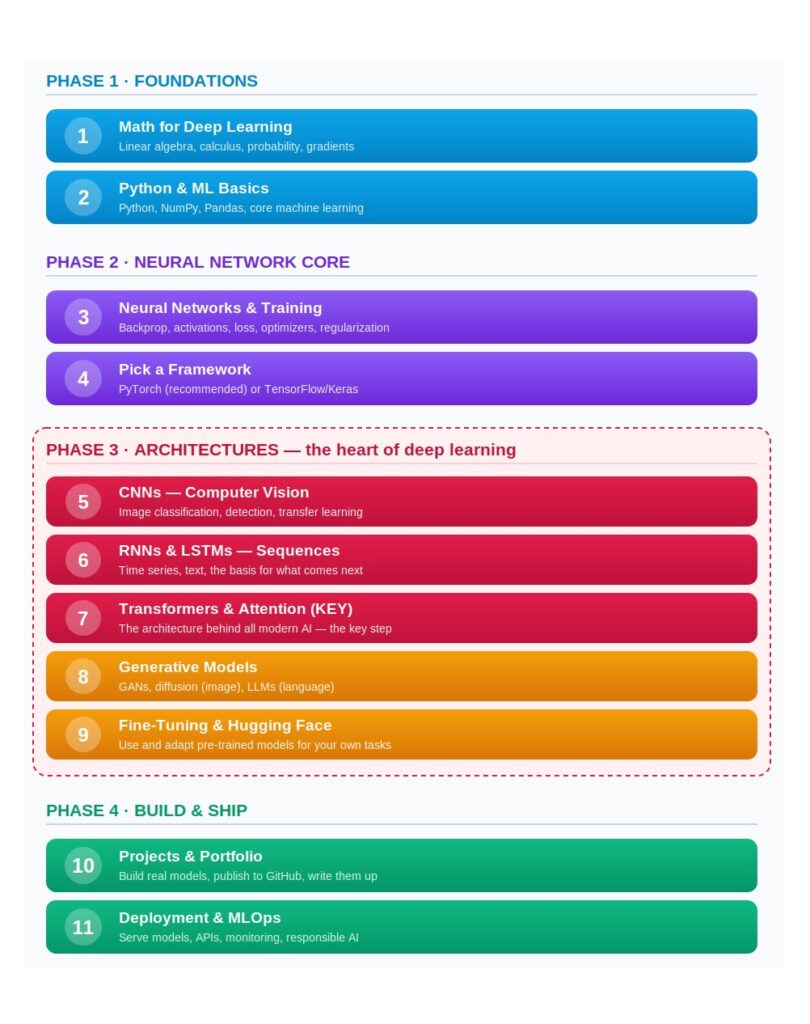
You learn deep learning in four phases. First, foundations: the math, Python, and basic machine learning. Second, the neural network core: how networks actually train, and picking a framework. Third, and this is the heart of it, the architectures: CNNs for images, RNNs for sequences, then transformers, and then generative models like GANs, diffusion, and LLMs. And fourth, you build real projects and learn to deploy them. The big update for 2026 is that transformers and generative models are now the center of the path, not an optional add-on at the end.
Now without any further ado, let’s get started-
Deep Learning Roadmap 2026
- Step 1. Brush up the math for deep learning
- Step 2. Learn Python and core machine learning
- Step 3. Learn how neural networks actually work
- Step 4. Pick a deep learning framework
- Step 5. CNNs: deep learning for images
- Step 6. RNNs and LSTMs: deep learning for sequences
- Step 7. Transformers and attention: the most important step
- Step 8. Generative models: GANs, diffusion, and LLMs
- Step 9. Fine-tuning and Hugging Face
- Step 10. Build real projects and a portfolio
- Step 11. Learn deployment and MLOps
Below is the full roadmap, step by step, with what to learn, how to know you’re ready to move on, a project for each stage, and the courses I’d point you to.
How I actually learned deep learning
Before the roadmap, let me tell you my story, because it’ll change how you use everything below.
When I started, I thought the way to learn deep learning was to understand everything before touching anything. So I collected theory. I watched lectures on matrix multiplication. I saved 40 PDFs I never opened. I could tell you what a derivative was on paper. But could I build a model that told a cat from a dog? No. I had all the ingredients and I never cooked once.
So this is the part nobody told me, and I’m telling you now. You don’t learn deep learning by understanding it first. You learn it the same way the network itself learns. You guess, you get it wrong, you adjust, you guess again. That’s literally what a neural network does when it trains. And it’s exactly how you learn too. Wrong, then a little less wrong, then it starts working.
Keep that idea in your head for the complete roadmap. Every step below works better if you build first and understand second, not the other way round. That one reordering is what finally made this field open up for me, after months of getting nowhere by studying theory I never used.
So as you go through the phases, follow this rule: build the dumbest possible version first, let it be wrong, then go learn why. You’ll learn more from one wrong model that runs than from ten perfect ones you only read about.
The deep learning roadmap 2026 at a glance
| Phase | Steps | What you learn |
|---|---|---|
| 1. Foundations | Math, Python + ML | Linear algebra, calculus, gradients, Python, core ML |
| 2. Neural network core | Neural nets, Framework | Backprop, training, PyTorch or TensorFlow |
| 3. Architectures ★ | CNNs, RNNs, Transformers, Generative models, Fine-tuning | The heart — vision, sequences, attention, GANs, diffusion, LLMs |
| 4. Build & ship | Projects, Deployment | Real models, portfolio, MLOps, responsible AI |
Optional depth: reinforcement learning, graph neural networks, vision transformers. Useful for specific roles, not required to start.
So you go phase by phase, and the architecture phase is where you spend the most time, because that’s where deep learning actually lives. If you want the broader picture of how deep learning fits into AI as a whole, I’ve got a full AI learning roadmap that covers the wider path. This one goes deep on deep learning specifically.
Now, let’s move to the step-by-step Deep Learning Roadmap–
Phase 1: Foundations
Step 1. Brush up the math for deep learning
So do you need heavy math? You need the core ideas, not a PhD. Deep learning rests on a few areas of math. And understanding them is what turns neural networks from something mysterious into something you actually get.
Focus on linear algebra, because everything in a neural network is vectors and matrices being multiplied. Calculus, especially derivatives and the chain rule, because that’s literally how networks learn through backpropagation. And probability and statistics, because that’s how you handle uncertainty and evaluate models. You don’t need to master all of it first, learn the basics and deepen it as each topic demands.
You’re ready to move on when you understand what a gradient is, why the chain rule drives training, and you’re not scared of matrix multiplication.
Where to learn it:
- Intro to Statistics (Udacity Free Course)
- Basic Statistics (Online Course)
- Statistics and probability (Khan Academy)
- Practical Statistics for Data Scientists (TextBook)
- Data Science: Statistics and Machine Learning Specialization (Online Course)
- Statistics for Data Science (YouTube Video)
- Mathematics for Data Science Specialization (Online Course)
- Khan Academy
- Data Science Math Skills (Online Course)
Step 2. Learn Python and core machine learning
Python is the language of deep learning, and machine learning is the layer right underneath it, so you want both before you touch neural networks.
Get comfortable with Python and the data libraries, NumPy and Pandas especially, since deep learning is all array math. Then learn core machine learning: what training and testing means, overfitting, and simple algorithms, because deep learning is a branch of ML and the concepts carry straight over. If you skip ML and jump to neural networks, you’ll hit walls that ML would have prepared you for.
Tools for this step: Python, NumPy, Pandas, scikit-learn, Google Colab (free GPUs, which you’ll want soon).
Your project: build a simple ML model, predicting something on a real dataset with scikit-learn. You’re ready to move on when you can train and evaluate a basic model and explain overfitting.
My take: my real turning point was the day I stopped studying and built a model that predicts one number. One input, one output. Predict a house price from its size, about twenty lines of code, half of which I didn’t fully understand. And it ran. It gave me a wrong number, then I trained it and the number got closer. For the first time the whole thing wasn’t scary. I had my hands inside it. So do that. Build the dumbest possible model on day one, before you understand it. That single wrong model teaches you more than three chapters of theory.
-Resources for Learning Python Programming-
- MLTUT Python FREE YouTube Course
- Introduction to Python Programming(Udacity Free Course)
- The Python Tutorial (PYTHON.ORG)
- CS DOJO (YouTube)
- Python 3 Tutorial (SOLOLEARN)
- Python For Data Science(Udemy Free Course)
- Programming with Mosh (YouTube)
- Corey Schafer (YouTube)
I am also going to list some free resources to learn R Programming. So, If you want to learn R, you can learn from these Free resources-
-Free Resources to Learn R-
- R Basics – R Programming Language Introduction(Udemy Free Course)
- R Programming (Coursera Free to Audit Course)
- Learn R Quickly (Udemy Free Course)
- R, ggplot, and Simple Linear Regression (Udemy Free Course)
- R Programming Tutorial (YouTube Tutorial)
- R Programming Full Course In 7 Hours (YouTube Tutorial)
-Resources for Learning Machine Learning–
- Introduction to Machine Learning Course(Udacity)
- Machine Learning: Unsupervised Learning (Udacity)
- Machine Learning by Stanford University(Coursera)
- Machine Learning for All by University of London(Coursera)
- What is Machine Learning?(Udemy)
- Machine Learning Fundamentals(edX)
Phase 2: The neural network core
Step 3. Learn how neural networks actually work
Now the deep learning proper. Before any fancy architecture, you need to understand the plain neural network, because every advanced model is built on these same mechanics.
Start with one neuron. Not a network, one neuron, because if you get one, you get the whole field. A neuron does something almost boring: it takes your inputs, multiplies each by a weight, adds them up, adds a small bias, and passes the result through a function. That’s the whole thing. The weight is just how much that input counts, a big weight says “pay attention to this,” a small one says “kind of ignore this.” And at the start, the weights are basically random. So the neuron is guessing. Training slowly nudges those weights until the guesses get good. A big network is just a lot of these stacked together. So don’t let anyone make it sound more complicated than that.
Then learn how it gets less wrong, which is the scary word everyone freezes at: backpropagation. Strip it down and it’s simple. The network makes a prediction, and you measure how wrong it was, that’s the loss. Backpropagation goes back through the network and works out, for every weight, “did you make this wrong, and by how much?” Then it nudges each weight a tiny bit in the direction that shrinks the loss. Do that thousands of times and the network gets good. That’s all training is: measure how wrong you are, nudge everything slightly toward less wrong, repeat.
Around that core, learn the supporting pieces: activation functions (ReLU, sigmoid, softmax), loss functions, optimizers like gradient descent and Adam, and regularization like dropout that stops overfitting.
One honest warning from me: do not try to derive the backprop math on paper on day one. I wasted weeks doing exactly that. Get the intuition first, the guess-wrong-adjust idea. The math makes far more sense after you’ve already seen it work, not before. Trust me on that order.
This step is the foundation everything else stands on. Once backpropagation stops being scary, the rest of deep learning opens up.
You’re ready to move on when you can explain, in your own words, how a network learns through backpropagation, and what an activation function and an optimizer do.
Where to learn it:
- Deep Learning Specialization (deeplearning.ai)
- Deep Learning– Udacity
- Intro to Deep Learning with PyTorch– Udacity FREE Course
- Intro to TensorFlow for Deep Learning– Udacity FREE Course
- Intro to Deep Learning– Kaggle
- Generative Adversarial Networks (GANs) Specialization– Coursera
- Become a Deep Reinforcement Learning Expert– Udacity
- Deep Learning: Convolutional Neural Networks in Python– Udemy
- Reinforcement Learning– Udacity
- Neural Networks and Deep Learning– Coursera
Step 4. Pick a deep learning framework
You won’t build networks from scratch every time, you’ll use a framework. So pick one and get fluent.
PyTorch is what I’d recommend in 2026. It’s dominant in research, increasingly in industry, and its style is intuitive and Pythonic. TensorFlow (with Keras) is the other major option, still widely used especially in production. Pick one, PyTorch for most people, and don’t waste time trying to learn both at once. The concepts carry over. So when you do need the other one later, it’s easy.
Tools for this step: PyTorch (recommended) or TensorFlow/Keras, plus Google Colab or Kaggle for free GPU access.
Your project: rebuild the neural network from Step 3, this time in your chosen framework, and train it on a real dataset. You’re ready to move on when you can define, train, and evaluate a network in your framework without following a tutorial line by line.
-Resources for Learning Deep Learning Frameworks–
- Intro to Deep Learning with PyTorch– Udacity FREE Course
- Intro to TensorFlow for Deep Learning– Udacity FREE Course
- Introduction to Deep Learning & Neural Networks with Keras– Coursera
- Advanced Deep Learning with Keras– Datacamp
- Deep Learning Fundamentals with Keras– edX
- Complete Tensorflow 2 and Keras Deep Learning Bootcamp- Udemy
- TensorFlow 2 for Deep Learning Specialization– Coursera
- Introduction to Deep Learning with PyTorch– DataCamp
- Deep Neural Networks with PyTorch– Coursera
- PyTorch: Deep Learning and Artificial Intelligence– Udemy
- PyTorch for Deep Learning with Python– Udemy
- PyTorch Tutorials– pytorch.org
Phase 3: The architectures: the heart of deep learning
So this is where deep learning actually happens, and it’s the part the old roadmaps completely under-cover. Each architecture below is suited to a different kind of data, and they build toward transformers, which is the one that changed everything. So spend the most time in this phase.
But this is the honest advice that saved me. Don’t try to learn all of these at once. Pick one lane and go deep. If you like images, go deep on CNNs. If you like text, go deep on the language side. Depth in one area teaches you the habits. How to train, how to debug, how to tell when your model is lying to you. And those habits carry everywhere. I went deep on text and local models, and that became my whole thing. After you’ve gone deep in one lane, jumping to a new one is easy. Trying to learn all of them at once just leaves you drowning.
Step 5. CNNs: deep learning for images
Convolutional neural networks, or CNNs, are how deep learning handles images, and they’re the natural first architecture to learn. They’re what powers image classification, object detection, and face recognition.
Learn how convolutions and pooling work, why CNNs are so good at images (they detect patterns regardless of position), and the famous architectures like ResNet. Then learn transfer learning, taking a model someone else trained on millions of images and adapting it to your task. That’s how real computer vision work actually happens, you rarely train from scratch.
Your project: build an image classifier, cats vs dogs, or a multi-class dataset, using transfer learning with a pre-trained CNN. It’s the classic and it teaches the whole workflow. You’re ready to move on when you can take a pre-trained CNN and fine-tune it on your own images.
Where to learn it:
- Convolutional Neural Networks– deeplearning.ai
- Deep Learning in Python– Datacamp
- Deep Learning: Convolutional Neural Networks in Python– Udemy
- Become a Computer Vision Expert– Udacity
- Deep Learning and Computer Vision A-Z™: OpenCV, SSD & GANs– Udemy
Step 6. RNNs and LSTMs: deep learning for sequences
Recurrent neural networks, RNNs, and their improved version LSTMs, are built for sequential data: text, time series, audio, anything where the order counts. For years they were how deep learning handled language.
Learn how RNNs process sequences step by step, why plain RNNs struggle with long sequences, and how LSTMs and GRUs fix that with memory. Understanding these is important even though transformers have largely replaced them, because RNNs teach you the problem that transformers were invented to solve. So this step sets up the next one.
Your project: build a text generator or a time-series predictor with an LSTM. You’re ready to move on when you understand why long sequences are hard for RNNs, because that’s exactly what transformers fix.
Step 7. Transformers and attention: the most important step
So this is the one. Transformers are the architecture behind every major AI system today, GPT, BERT, Gemini, Claude, all of them. In 2026, you cannot understand modern deep learning without transformers.
So let me actually walk you through what makes a transformer work, because “learn transformers” is too vague to act on, and this is the concept everything else in modern AI rests on.
Start with the problem. RNNs read a sentence one word at a time, in order, which makes them slow and makes them forget things that came far back. Transformers fix both at once by reading the whole sequence at the same time.
The trick that lets them do that is attention. So let me put the idea in plain terms. For every word, the model asks “which other words in this sentence should I pay attention to, to understand this one?” In the sentence “the animal didn’t cross the street because it was tired,” attention is what lets the model figure out that “it” refers to the animal, not the street. It does this by scoring how relevant every other word is to the current one, and weighting them accordingly. That’s it, that’s attention: a way of letting every word look at every other word and decide what counts.
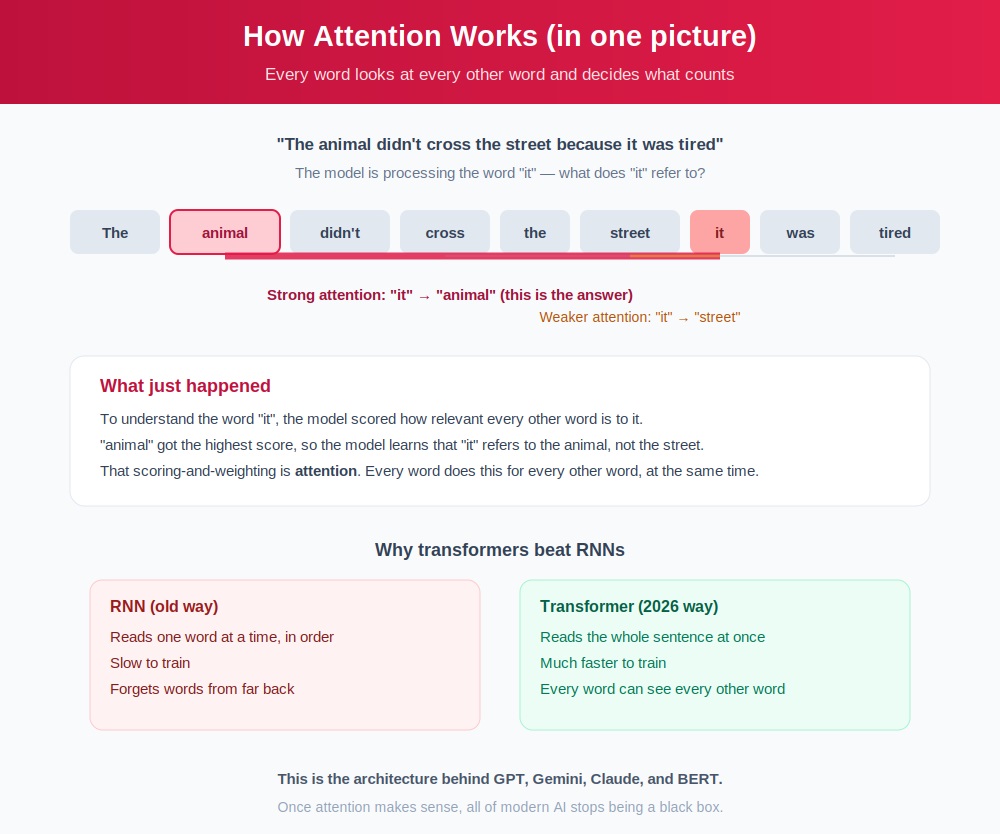
Then a transformer stacks a lot of these attention layers together, which is how it builds up a deep understanding of language (or images, or code). Learn the two main flavours too: encoder models like BERT, which are great at understanding text (classification, search), and decoder models like GPT, which are great at generating it. Most of the models you’ve heard of, GPT, Gemini, Claude, are decoder-style transformers.
You don’t need to build a transformer from scratch. You need to understand attention well enough that these models stop feeling mysterious, and then use pre-trained ones from Hugging Face. But this understanding is the single highest-value thing on this whole roadmap. Because when attention finally makes sense to you, all of modern AI suddenly does too. So go slow here. Rewatch explanations. And don’t move on until “attention” feels like a real mechanism to you, not a buzzword.
Your project: use a pre-trained transformer from Hugging Face to do a real task, text classification or summarization, and read one clear explanation of attention until you can describe it in your own words. You’re ready to move on when you understand what attention does and why transformers replaced RNNs.
Where to learn it:
- Generative AI Language Modeling with Transformers– IBM
- Transformer Models and BERT Model– Google Cloud
- Generative AI Engineering and Fine-Tuning Transformers– IBM
- Transformers and NLP: Fine-Tuning Models with Hugging Face– Board Infinity
- Generative Pre-trained Transformers (GPT)– University of Glasgow
Step 8. Generative models: GANs, diffusion, and LLMs
Generative deep learning is where models create new content, and it’s the most exciting area of the field in 2026. There are three families worth knowing.
GANs (generative adversarial networks) pit two networks against each other to generate realistic images, they were the big generative breakthrough. Diffusion models are what now power the best image generators like Stable Diffusion, learning to create images by reversing a noising process.
And LLMs (large language models) are transformer-based models trained on huge text data, the GPT and Gemini family. And in 2026 the big models are multimodal, meaning they handle text, images, and audio together in one model, like GPT-4o and Gemini. So it’s worth knowing that generative AI isn’t just text anymore.
A modern model can look at an image, read text, and respond to both at once, and that multimodal ability is one of the defining shifts of the last year. Learn what each family does and when it’s used. You don’t need to train these from scratch. You need to understand how they work and how to build with them.
Your project: generate images with a pre-trained diffusion model, or build something with an LLM API. You’re ready to move on when you can explain the difference between GANs, diffusion, and LLMs, and what each is good for.
Where to learn it:
- Introduction to Generative Adversarial Networks– Udacity
- Generative Adversarial Networks (GANs) Specialization– Coursera
- Generative Deep Learning with TensorFlow– Coursera
- Introduction to Generative AI with Google Cloud– Udacity FREE Course
- Deep Generative Models– Udemy
- Generative AI Concepts– DataCamp
- Generative AI for Business– DataCamp
Step 9. Fine-tuning and Hugging Face
The last architecture skill is adapting existing models to your own needs, because in 2026 almost nobody trains large models from scratch, they fine-tune.
Learn what fine-tuning is (continuing training on your own data for a specific task), when to fine-tune versus just prompting or using RAG, and efficient methods like LoRA that let you fine-tune big models cheaply. And learn Hugging Face properly, it’s the hub for pre-trained models, datasets, and tools, and it’s central to modern deep learning work.
Where to learn it:
What’s on the deep learning frontier in 2026
So you don’t need these to start, but you should know they exist, because they’re where the field is heading and people will ask you about them.
AI agents (agentic AI) are the biggest trend right now. An agent is a system where a model doesn’t just answer, it plans, uses tools, and takes actions on its own, in a loop, until a task is done. This sits more on the AI-application side than the pure deep learning side, so I cover it properly in my AI learning roadmap. But know that after you’ve got the deep learning foundations here, agents are the natural next thing to build.
Reasoning models are the other big shift. These are models trained to think step by step before they answer, which makes them far better at hard problems in math, code, and logic. The o1 and o3 style models kicked this off, and it’s changing what LLMs can do.
Mixture of Experts (MoE) is the architecture behind most frontier models now. Instead of running the whole giant network for every input, it routes each input to a small set of specialized “expert” sub-networks, which is how models got much bigger without getting much slower. It’s advanced, so don’t worry about it early, but that’s the name to know.
So none of these change your starting path. You still learn the foundations, then architectures, then transformers. But these three, agents, reasoning models, and MoE, are what “cutting edge” means in 2026, and now you know where they fit.
Phase 4: Build and ship
Step 10. Build real projects and a portfolio
So let me be honest with you. Nobody gets a deep learning job off certificates. They get it off projects. So this step counts more than any course above.
Build things that show range. An image classifier with a CNN. A text project with a transformer. A generative project with diffusion or an LLM. Put them on GitHub, write up what you did and why, and deploy a demo where you can. That portfolio is what proves you can actually do deep learning, not just watch videos about it. And start building from Phase 3 onward, you learn most when you’re stuck on your own project.
Step 11. Learn deployment and MLOps
The final step is getting a model out of your notebook and into the real world. Learn to serve a model behind an API, containerize it with Docker, deploy to the cloud, and monitor it once live. And learn the basics of responsible AI, bias, fairness, and safety, because in 2026 that’s part of the job, not an afterthought.
You don’t need to master all of MLOps to get hired, but understanding how a model reaches users is what makes you a complete deep learning engineer.
Where to learn it:
- MLOps (Machine Learning Operations) Fundamentals– Coursera
- Cloud Machine Learning Engineering and MLOps– Coursera
- Open Source Platforms for MLOps– Coursera
- Python Essentials for MLOps– Coursera
- Complete MLOps Bootcamp– Udemy
- MLOps Fundamentals– Udemy
- Azure Machine Learning & MLOps: Beginner to Advance– Udemy
- Machine Learning Engineering for Production (MLOps) Specialization– Coursera
How long does the deep learning roadmap take?
So how long? It depends on your starting point. But let me give you a realistic frame at 10 to 15 hours a week. Foundations and the neural network core take about 3 to 4 months. The architecture phase, the heart of it, takes another 4 to 5 months. There’s a lot there, and it’s worth going slow. And projects are ongoing. So a committed learner reaches a solid, job-relevant level in roughly 8 to 12 months. Faster if you already know Python and machine learning.
Don’t rush the architecture phase to “finish.” That’s the part that actually makes you a deep learning engineer, so it deserves the time.
When you should NOT use deep learning
One honest thing most roadmaps won’t tell you: deep learning isn’t the answer to everything, and knowing when to skip it is a real skill that marks you out as someone who actually understands the field.
If your data is small, or your problem is simple, a plain old machine learning model will often beat a neural network, and it’ll be faster to train and easier to explain. Deep learning earns its keep when you have a lot of data and a messy problem, like images, language, or audio, where you can’t just write the rules by hand. Reaching for a giant neural network on a tiny, simple problem is like using a moving truck to carry one grocery bag. I was that person early on, so learn from me: match the tool to the problem, and sometimes the right tool isn’t deep learning at all.
Common mistakes I see people make
So I’ve watched a lot of people learn this, and a few mistakes come up again and again.
Skipping the neural network fundamentals to get to the exciting topics. People rush past backpropagation to play with LLMs, then hit a wall because they don’t understand what’s underneath. Learn the basics properly, they pay off everywhere.
Never learning transformers. Some people follow an old roadmap, learn CNNs and RNNs, and stop, thinking they’re done. In 2026 that leaves out the single most important architecture. Don’t stop before transformers.
Trying to train everything from scratch. Beginners think real deep learning means training huge models yourself. It doesn’t. Transfer learning and fine-tuning pre-trained models is how the actual work is done. Learn to stand on existing models.
Collecting courses instead of building. Tutorial hell is real. You learn deep learning by building models that break and fixing them, not by watching one more course. Build from Phase 3 onward.
Expecting it to work the first time. So this is the part nobody warns you about. Your model will fail a lot, and it usually fails silently. It won’t crash, it’ll just be bad, with no error message telling you why. Some days you’ll change one number and everything breaks. Some days you’ll stare at a loss that won’t go down and want to quit. That’s not you being bad at this, that is literally the job, even people who do this for a living spend most of their time confused and fixing broken things. So the real skill you’re building isn’t math, it’s the patience to be wrong for a while without giving up.
Deep learning vs machine learning: where does this fit?
Quick clarification, since people mix these up. Machine learning is the broad field of systems that learn from data. Deep learning is a subset of machine learning that uses neural networks with many layers, and it’s what powers modern AI like image generation and LLMs.
So you learn some machine learning first (Phase 1), then go deep on the neural network path here. If you want the full picture of how deep learning sits inside AI and machine learning, my AI learning roadmap lays out the whole hierarchy.
Now it’s time to wrap up!
FAQ
One last thing before you start
Let me name what you’ll actually have if you follow this. You’ll have built a tiny model on day one instead of hiding from the theory. You’ll understand one neuron, which means you understand all of them. You’ll get what training really is, being wrong and adjusting, over and over. And you’ll have gone deep in one lane instead of drowning in all of them. That’s a real foundation, not a certificate, a foundation.
So this is what I want you to do next. Before you lose the momentum, go build the dumbest model you can think of. Make it predict one number. Let it be wrong. Because that’s the first nudge, and you already know what comes after the first nudge: guess, be wrong, adjust. You’ve got this.
Conclusion
In this article, I have discussed a step-by-step Deep Learning Roadmap 2026. If you have any doubts or queries, feel free to ask me in the comment section. I am here to help you.
So that’s the complete deep learning roadmap for 2026. Foundations, the neural network core, then the architectures, CNNs, RNNs, transformers, and generative models, and then building and shipping real projects. The biggest thing to take from it is that the path now builds toward transformers and generative models, that’s what deep learning is today, and it’s exactly what older roadmaps miss.
Start with the foundations, go slow through the architecture phase, and build projects as you learn. If you do the work, deep learning is one of the most rewarding and in-demand skills you can have right now.
If you found this roadmap helpful or you’re on the journey, drop a comment. I read and reply to every one, and I love hearing how people are getting on.
All the Best for your Career!
Happy Learning!
You May Also be Interested In
8 Best Advanced Deep Learning Courses Online You Must Know in 2026
How Good is Udacity Deep Learning Nanodegree in 2026?
Deep Learning vs Neural Network, The Main Differences!
What is Generative Adversarial Network? All You Need to Know
Top 5 Deep Learning Algorithms List, You Need to Know
What is Convolutional Neural Network? Super Easy Explanation!
Top 6 Skills Required for Deep Learning That Will Make You Expert!
Stochastic Gradient Descent- A Super Easy Complete Guide!
Thank YOU!
Learn Deep Learning Basics here.
Thought of the Day…
‘ Anyone who stops learning is old, whether at twenty or eighty. Anyone who keeps learning stays young.
– Henry Ford

Written By Aqsa Zafar
Aqsa Zafar is a Ph.D. scholar in Machine Learning at Dayananda Sagar University, specializing in Natural Language Processing and Deep Learning. She has published research in AI applications for mental health and actively shares insights on data science, machine learning, and generative AI through MLTUT. With a strong background in computer science (B.Tech and M.Tech), Aqsa combines academic expertise with practical experience to help learners and professionals understand and apply AI in real-world scenarios.