
Are you looking for the Best Online DevOps Courses?… If yes, you are in the right place. I have listed the 7 Best Online DevOps Courses and Certifications from various platforms in this article.
So DevOps. Everyone kept telling me to learn it. But every time I searched, I got a hundred courses and no idea where to start. Sound familiar? Yeah, I’ve been there.
So I actually went and took these courses myself over the past year. Some were amazing. Some I gave up on halfway. So in this article I’m not just listing random courses, I’m telling you which ones actually helped me and where each one fits.
Quick answer before the detail. If you’re a total beginner, start with the Coursera Introduction to DevOps, it’s short and concept-first. If you want the deepest hands-on path with real projects, the Udacity Cloud DevOps Engineer Nanodegree is the one. If you already know Python and ML like me, the Machine Learning DevOps Engineer Nanodegree is your natural next step. And if you just want the AWS certification, there’s a specific Udemy course for that. Let me break down all seven.
Now, without any further ado, let’s get started-
Best Online DevOps Courses
- Best Online DevOps Courses
- Best online DevOps courses at a glance
- What is DevOps, and what will you actually learn?
- The DevOps skills roadmap: what to learn, in order
- 1. Become a Cloud DevOps Engineer: Udacity
- 2. Introduction to DevOps: Coursera
- 3. DevOps Beginners to Advanced: Udemy
- 4. Machine Learning DevOps Engineer: Udacity
- 5. DevOps on AWS Specialization: Coursera
- 6. Cloud DevOps using Microsoft Azure: Udacity
- 7. AWS Certified DevOps Engineer Professional: Udemy
- DevOps salary and career outlook in 2026
- How to choose the right DevOps course for you
- Are DevOps courses worth it, and can they get you a job?
- Do you need to know coding before learning DevOps?
- FAQ
- Conclusion
- You May Also Be Interested In
Best online DevOps courses at a glance
| S/N | Course | Platform | Best for | Length | Price (verify) |
|---|---|---|---|---|---|
| 1 | Cloud DevOps Engineer (Nanodegree) | Udacity | Deep hands-on projects | ~4 months | ~$249/mo |
| 2 | Introduction to DevOps | Coursera | Total beginners | ~9 hours | ~$49/mo |
| 3 | DevOps Beginners to Advanced | Udemy | A lifetime reference | ~51 hours | ~$10–15 |
| 4 | Machine Learning DevOps Engineer | Udacity | MLOps (if you know Python/ML) | ~4 months | ~$249/mo |
| 5 | DevOps on AWS Specialization | Coursera | Learning AWS from zero | ~4 months | ~$49/mo |
| 6 | Cloud DevOps using Microsoft Azure | Udacity | Azure specifically | ~4 months | ~$249/mo |
| 7 | AWS Certified DevOps Engineer Professional | Udemy | Cert prep (advanced) | ~20 hours | ~$10–15 |
All verified live July 2026. Prices vary and courses run sales, so confirm the current number before enrolling.
What is DevOps, and what will you actually learn?
Before the courses, let me quickly orient you, because if you’re new, “DevOps” is a fuzzy word and it helps to know what you’re signing up to learn.
DevOps is the practice of getting software built, tested, released, and running reliably, by bringing development and operations together and automating as much of it as possible. So instead of developers writing code and throwing it over a wall to an ops team, DevOps is one connected, automated flow from code to production. That’s the whole idea, ship faster, break less, fix quickly.
So what does that mean in terms of actual skills and tools you’ll learn in these courses? A few core areas come up again and again, so let me lay out what to expect.
You’ll learn Linux and scripting, because almost everything in DevOps runs on Linux and you automate it with scripts. You’ll learn CI/CD (continuous integration and continuous deployment) using tools like Jenkins and GitHub Actions, which is the automated pipeline that takes your code and gets it live without manual steps. You’ll learn containers with Docker, which package an app so it runs the same everywhere, and Kubernetes, which runs and scales those containers across many machines. You’ll learn infrastructure as code with Terraform or CloudFormation, so you build servers by writing code instead of clicking around. You’ll learn configuration management with Ansible. And you’ll learn a cloud platform, usually AWS or Azure, since that’s where most of this actually runs, plus monitoring to keep an eye on it all once it’s live.
So when you see those words in the courses below, that’s what they mean, and that’s the toolkit you’re building toward. You don’t learn them all at once, which brings me to the order I’d learn them in.
The DevOps skills roadmap: what to learn, in order
So DevOps has a lot of tools, and the biggest mistake beginners make is grabbing them randomly. So let me give you the order that actually builds on itself, and it’s the order these courses roughly follow too.
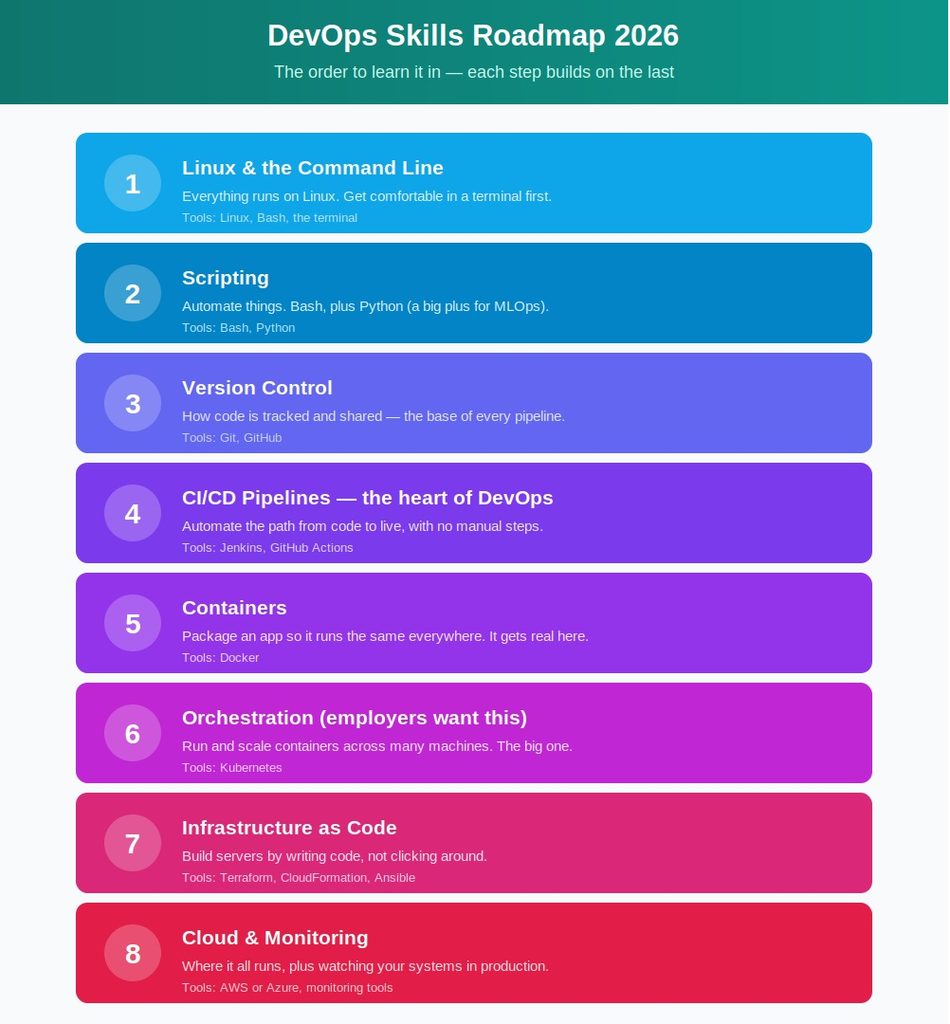
Step 1: Linux and the command line. Everything sits on this. Get comfortable in a terminal first.
Step 2: A scripting language. Bash for automation, and Python is a big plus, especially if you’re heading toward MLOps like I did.
Step 3: Version control with Git. How code is tracked and shared, the foundation of every pipeline.
Step 4: CI/CD pipelines. Jenkins or GitHub Actions. This is the heart of DevOps, automating the path from code to live.
Step 5: Containers with Docker. Package your app so it runs anywhere. This is where it starts feeling real.
Step 6: Orchestration with Kubernetes. Run and scale those containers. This is the big one employers want, and it’s harder, so don’t rush to it.
Step 7: Infrastructure as code. Terraform or CloudFormation, build your infrastructure by writing code.
Step 8: A cloud platform and monitoring. AWS or Azure, plus tools to watch your systems in production.
So if you follow that order, each skill makes the next one simpler. Total beginners should start at Step 1 with the Coursera concepts course below. If you already code, you can jump toward the containers and CI/CD steps with the hands-on courses.
1. Become a Cloud DevOps Engineer: Udacity
Best for: deep, hands-on learning with real projects
Time to Complete: ~4 months
Price: ~$249/month
So this one I actually took seriously because of the projects. The CloudFormation part scared me at first, writing infrastructure as code felt weird. But after I deployed that high-availability web app, it made sense. The Kubernetes cluster project at the end is where I felt like a real DevOps engineer.
You learn the cloud fundamentals, then infrastructure as code with CloudFormation, then CI/CD, and finally you build and deploy a Kubernetes cluster with autoscaling. The projects are the real value: you deploy a static website on AWS, build a high-availability web app with CloudFormation, set up an automated CI/CD pipeline, and stand up a Kubernetes microservices cluster. By the end you’ve actually built the things a junior DevOps engineer does at work, and that’s your portfolio. It’s the most complete hands-on path on this list.
Heads up though, it’s not cheap and you need to keep pace, or the four months slip away from you. So only start this when you can commit real hours each week.
See the Cloud DevOps Engineer Nanodegree →
2. Introduction to DevOps: Coursera
Best for: total beginners
Time to Complete: ~9 hours
Price: ~$49/month (or audit)
This is the one I tell total beginners to start with. It’s only nine hours. No coding pressure, just the concepts. The “working in small batches” idea stuck with me the most, I didn’t get why it counted until this course explained it plainly.
So if DevOps is completely new to you and you don’t even know the vocabulary yet, this builds the base before you touch any tool. Don’t skip the fundamentals to rush to Kubernetes, this short course saves you confusion later.
3. DevOps Beginners to Advanced: Udemy
Best for: a lifetime hands-on reference
Time to Complete: ~51 hours
Price: ~$10–15 on sale
Okay this one is huge. 51 hours. I did not finish it in one go. But the hands-on demos are the reason I recommend it. You go through Linux basics, shell scripting, Git, Docker, Kubernetes, Terraform, Ansible, Jenkins, and AWS, basically the entire toolchain from the roadmap above, all in one place with demos you follow along and build.
And the lifetime access saved me. I kept coming back to the Ansible and Jenkins sections whenever I forgot something. So treat this one like a reference you own forever, not a course you binge. At around $10 to $15 in a Udemy sale, owning all of that to dip into whenever you’re stuck is genuinely great value.
See DevOps Beginners to Advanced →
4. Machine Learning DevOps Engineer: Udacity
Best for: MLOps, if you already know Python and ML
Time to Complete: ~4 months
Price: ~$249/month
This one is close to my heart because it’s MLOps, not just DevOps. If you already know Python and ML like me, this is the natural next step.
The clean-code and unit-testing part felt boring at first. But then I realised that’s exactly what I was missing in my own ML projects. Setting up CI with GitHub Actions and deploying with Heroku was the fun part, and it’s the stuff that turns a notebook model into something that actually runs in production.
So this isn’t for DevOps beginners, it’s for data and ML people who want to learn how to deploy and maintain their models properly. If that’s you, it’s the best fit on this list. It pairs well with the deployment step in my AI learning roadmap.
See the Machine Learning DevOps Engineer Nanodegree →
5. DevOps on AWS Specialization: Coursera
Best for: learning AWS specifically, from zero
Time to Complete: ~4 months
Price: ~$49/month
Good pick if you want AWS specifically. What I liked is it starts from zero, no prior AWS needed. You build one app step by step across the courses.
And I liked that it didn’t just teach tools, it made me think about when to automate, which is the actual DevOps mindset, not just the commands. The peer-graded assignments were annoying, but honestly they made me slow down and actually understand instead of rushing through.
So if AWS is your target cloud and you want a structured, build-as-you-go path, this is a solid choice.
See DevOps on AWS Specialization →
6. Cloud DevOps using Microsoft Azure: Udacity
Best for: Azure specifically
Time to Complete: ~4 months
Price: ~$249/month
I took this because most courses only teach AWS, and I wanted Azure too. The Terraform part overlaps with other courses, so that felt like revision. But the Azure Pipelines and Selenium UI testing part was new for me, and it preps you for Microsoft’s AZ-400 DevOps certification.
Quick heads up, you need Python and Linux basics before starting, or you’ll struggle. So don’t make this your first course. But if you specifically want Azure rather than AWS, it’s the one to pick.
See Cloud DevOps using Microsoft Azure →
7. AWS Certified DevOps Engineer Professional: Udemy
Best for: AWS certification prep (advanced)
Time to Complete: ~20 hours
Price: ~$10–15 on sale
This one is not for beginners. Don’t start here. I only got value from it because I already had AWS experience.
It’s short, around 20 hours, and it’s really aimed at the certification. So if you want the AWS Certified DevOps Engineer Professional cert, this is your prep. If you’re still learning the basics, come back to it later. Buying it in a sale and keeping it for when you’re cert-ready is the smart move.
See AWS Certified DevOps Engineer Professional →
DevOps salary and career outlook in 2026
So is all this learning actually worth it money-wise? Let me give you the real numbers, because “is DevOps a good career” deserves a straight answer, not hype.
DevOps pays well, and it stays in high demand. In the US in 2026, entry-level DevOps engineers earn roughly $80,000 to $95,000 a year, mid-level engineers with a few years of experience earn around $110,000 to $135,000, and senior engineers clear $140,000 to $175,000 and up, with total compensation at big tech companies going well past $200,000 after you add bonuses and equity. The average base salary sits somewhere around $115,000 to $134,000 depending on the source and your location.
And the demand is real, not just salary hype. Companies everywhere keep automating their infrastructure and deployment, so people who can build and run reliable pipelines are genuinely sought after. On top of that, the field is growing into new areas, DevSecOps (DevOps with security built in) is one of the best-paid specializations, and MLOps (DevOps for machine learning, which one of the courses below teaches) is growing fast as more companies put AI models into production.
One honest note on what employers actually want in 2026: basic CI/CD knowledge alone no longer makes you stand out. The engineers who earn the top salaries can design cloud platforms, work fluently with Kubernetes, handle security, and explain trade-offs to a business. So the path to the higher numbers is moving from just operating tools to genuinely owning the platform, which is exactly what the project-heavy courses below help you start doing.
So yes, DevOps is a strong career bet in 2026, good pay, high demand, and clear room to grow into even better-paid specializations. The courses are the on-ramp.
How to choose the right DevOps course for you
So seven courses is a lot. Let me make the choice simple, based on where you are right now.
If you’re a total beginner and don’t know the vocabulary yet, start with the Coursera Introduction to DevOps. If you want the deepest hands-on path and can commit four months, go for the Udacity Cloud DevOps Engineer Nanodegree. If you want one affordable resource to own and refer back to forever, grab the Udemy DevOps Beginners to Advanced in a sale. If you already know Python and ML, the Machine Learning DevOps Engineer Nanodegree is your path. If you want a specific cloud, DevOps on AWS Specialization for AWS, or the Azure Nanodegree for Azure. And if you’re chasing the AWS cert, the Udemy cert-prep course.
One honest thing I learned the hard way. Don’t try to do all of these at once. I did that and burned out. Pick one based on where you are, finish it, then move to the next.
Are DevOps courses worth it, and can they get you a job?
Quick honest answer, since people ask. DevOps courses are worth it if you actually build the projects, not just watch the videos. What gets you hired in DevOps is showing you can deploy and automate real infrastructure, so the courses with hands-on projects (the Udacity Nanodegrees especially) are the ones that translate to a job. Pair a course with your own projects on GitHub, a CI/CD pipeline you built, a Kubernetes app you deployed, and that portfolio is what actually lands the interview. The certificate helps, the demonstrated skill helps more.
Do you need to know coding before learning DevOps?
You need some basics, not deep expertise. For the beginner Coursera course, no coding needed, it’s concepts. But for the hands-on Nanodegrees and the Azure course, you’ll want Python and Linux basics first, or you’ll struggle like I warned above. So if you’re brand new, start with the concepts course and pick up basic Python and Linux alongside, then move to the project-heavy courses after you’re comfortable.
FAQ
And here the list ends. I hope these Best Online DevOps Courses will help you to learn DevOps. I would suggest you bookmark this article for future referrals. Now it’s time to wrap up.
Conclusion
And that’s my honest experience with all seven DevOps courses. One thing I learned the hard way, don’t try to do all of these at once. I did that and burned out. So pick one based on where you are right now.
Total beginner? Start with the Coursera intro. Want the deepest hands-on path? The Udacity Cloud DevOps Engineer Nanodegree. Already know Python and ML? Go for the MLOps one. And if you want the AWS cert, you know which one to grab.
That’s it from me. If you’ve taken any of these, tell me in the comments how it went for you, I read all of them. All the best, and enjoy learning.
You May Also Be Interested In
10 Best Online Courses for Data Science with R Programming
8 Best Free Online Data Analytics Courses You Must Know in 2026
Data Analyst Online Certification to Become a Successful Data Analyst
8 Best Books on Data Science with Python You Must Read in 2026
14 Best+Free Data Science with Python Courses Online- [Bestseller 2026]
10 Best Online Courses for Data Science with R Programming in 2026
8 Best Data Engineering Courses Online- Complete List of Resources
Thank YOU!
Explore More about Data Science, Visit Here
Thought of the Day…
‘ It’s what you learn after you know it all that counts.’
– John Wooden

Written By Aqsa Zafar
Aqsa Zafar is a Ph.D. scholar in Machine Learning at Dayananda Sagar University, specializing in Natural Language Processing and Deep Learning. She has published research in AI applications for mental health and actively shares insights on data science, machine learning, and generative AI through MLTUT. With a strong background in computer science (B.Tech and M.Tech), Aqsa combines academic expertise with practical experience to help learners and professionals understand and apply AI in real-world scenarios.