
Are you looking to learn new things online but feeling overwhelmed with all the options? Don’t worry! In this blog, I will compare Coursera Vs Coursera Plus. After reading this blog, you will have a clear understanding between Coursera and Coursera Plus.
If you’re trying to work out the difference between Coursera and Coursera Plus, and whether the subscription is actually worth paying for, the honest answer comes down to one number: how many courses you’ll take in a year. Everything else follows from that.
So here’s the short version before the detail.
Regular Coursera is pay-as-you-go. You pay per course or per specialization (about $49–79 a month each), and it suits you if you’ll take just one or two things a year.
Coursera Plus is the subscription: $59 a month, or $399 a year (which works out to about $33 a month). It gives you unlimited access to roughly 90% of Coursera’s courses and specializations for that one fee, and it makes sense once you’ll take three or more paid courses in a year.
But there’s one catch nobody explains clearly, and it’s the thing most likely to cost you money if you don’t know it: Coursera Plus does not unlock everything. The big Professional Certificates from Google, IBM, and Meta, plus degrees, work differently. I’ll explain exactly what’s included and what isn’t below, because that’s the detail that actually decides whether Plus is worth it for you.
See the current Coursera Plus price and free trial →
So, let’s dive in and discover which one suits you best!
Coursera Vs Coursera Plus
- Coursera vs Coursera Plus: quick comparison
- The short answer: is Coursera Plus worth it?
- Let me actually show you the math
- What is Coursera (the regular, pay-as-you-go option)?
- What is Coursera Plus?
- What Coursera Plus does NOT include (read this before you buy)
- How much does Coursera Plus cost in 2026?
- Coursera Plus vs Coursera Premium, Professional Certificates, and Specializations
- My take on Coursera Plus
- Who should get Coursera Plus (and who shouldn't)
- Can you get Coursera Plus for free?
- Is Coursera trustworthy?
- How to get Coursera Plus cheaper
- Coursera Plus price by country (regional pricing)
- Conclusion
- FAQ
Coursera vs Coursera Plus: quick comparison
| Regular Coursera | Coursera Plus | |
|---|---|---|
| How you pay | Per course / specialization | One subscription (monthly or annual) |
| Cost | ~$49–79/month per course | $59/month or $399/year (~$33/mo) |
| Free trial | Free audit (no certificate) | 7-day trial (monthly); annual has 14-day refund |
| Courses covered | Any single course you pay for | ~90% of courses + specializations |
| Certificates | Pay per certificate | Included for everything in Plus |
| Professional Certificates (Google/IBM/Meta) | Available (per subscription) | ⚠️ Included for most, but confirm the specific one |
| Degrees / MasterTrack | Separate paid programs | ❌ Not included |
| Best for | 1–2 courses a year | 3+ courses a year, or a broad learning plan |
| Commitment | None | Annual for best value (monthly to test) |
The short answer: is Coursera Plus worth it?
It comes down to a simple calculation. A single Coursera specialization or Professional Certificate costs roughly $49–79 a month until you finish it. So if you take just one and finish in a couple of months, paying individually is cheaper.
But the moment you’ll take three or more paid courses or specializations in a year, Coursera Plus is the cheaper route, because the annual plan costs less than buying two or three specializations separately. That’s the whole decision in one line: fewer than three courses a year, stay on regular Coursera; three or more, get Plus.
For most people who are seriously upskilling, data, AI, business, design, three courses a year is easy to hit, which is why Plus works out cheaper for them. For someone who just wants one specific certificate and then they’re done, it doesn’t.
Let me actually show you the math
So people say “three courses and Plus is cheaper,” but nobody shows you the numbers. Let me do it, because once you see it, the decision is obvious.
Say a specialization costs about $59 a month, and most take three to four months to finish. So one specialization runs you roughly $180–240. Fair enough for one.
Now say you plan to do three this year. Bought separately, that’s around $540–720. And Coursera Plus Annual is $399 for everything. So you save $140 to $320, and you get unlimited extra courses on top. Right?
The break-even in one look:
| Courses this year | Buy individually | Coursera Plus Annual | Cheaper option |
|---|---|---|---|
| 1 course | ~$180–240 | $399 | Buy individually |
| 2 courses | ~$360–480 | $399 | About even |
| 3 courses | ~$540–720 | $399 | Plus saves ~$140–320 |
| 5+ courses | ~$900+ | $399 | Plus, easily |
So one course, pay as you go. Two, it’s a toss-up. Three or more, Plus wins, and it’s not close. That’s the whole decision in one table.
What is Coursera (the regular, pay-as-you-go option)?
Regular Coursera is the standard way the platform works. You browse courses from universities and companies, and you pay for what you want individually, either a one-off course, or a monthly subscription to a specific specialization or Professional Certificate until you complete it.
You can also audit most courses for free, which gives you the video lessons and readings without the graded assignments or the certificate. So if you only want to learn and don’t need proof, regular Coursera can cost you nothing. You only pay when you want the certificate or the graded work.
This suits occasional learners, someone taking one course out of interest, or working through a single certificate for a specific job goal.
What is Coursera Plus?
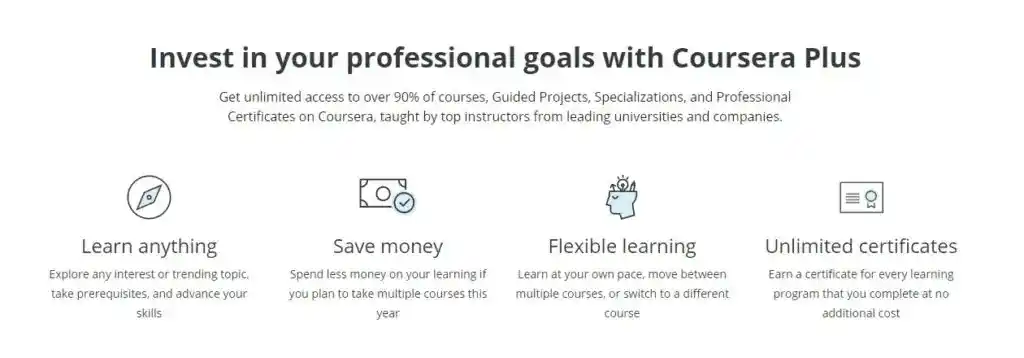
Coursera Plus is the all-access subscription. For one fee, $59 a month or $399 a year, you get unlimited access to about 90% of Coursera’s catalogue: courses, specializations, guided projects, and the certificates that come with them, all included at no extra cost.
The appeal is that you stop thinking about the price of each course. You can start a data science specialization, drop into a photography course, try a business one, and none of it adds to your bill. For someone who learns continuously across different subjects, that freedom is the entire point.
The value math is real: one Google Professional Certificate at the standalone rate can cost around $294 over six months. With Plus Annual at $399, often under $300 in a sale, you get that plus unlimited other courses for a year.
See what’s included with Coursera Plus →
What Coursera Plus does NOT include (read this before you buy)
This is the part almost every comparison skips, and it’s the one that causes buyer’s regret, so let me be clear.
Coursera Plus covers roughly 90% of the catalogue, but it does not include everything:
Degrees and MasterTrack certificates are separate paid programs, Plus does nothing for those. A small number of specialized university courses sit outside Plus. And most importantly, while many Professional Certificates (Google, IBM, Meta) are included, some specific programs and newer releases are not, so you must check the individual certificate page for the “Included with Coursera Plus” label before you subscribe expecting it.
So to make this concrete, here’s what’s covered and what isn’t.
Included with Plus, in most cases: the big specializations like Andrew Ng’s Machine Learning and Deep Learning, most university courses, guided projects, and many of the Professional Certificates from Google, IBM, and Meta. So for the vast majority of upskilling, Plus covers it.
Not included: full degrees and MasterTrack certificates, and a small number of specific courses and newer certificate programs. Those you pay for separately, no matter what.
So the practical rule is simple. Before you buy Plus for one specific goal, open that exact course or certificate page and look for the “Included with Coursera Plus” label. If you’re subscribing just to get one particular Google or IBM certificate, check it’s actually covered rather than assuming. That five-second check is what separates people who are happy with Plus from people who feel misled.
How much does Coursera Plus cost in 2026?
Here are the current numbers, and this is one of the most-searched things about Plus, so let me be exact.
Coursera Plus Monthly is $59 per month, and it comes with a 7-day free trial. You can cancel anytime, so it’s the right choice if you’ll finish your learning in three or four months, take your courses fast, then cancel.
Coursera Plus Annual is $399 per year, which works out to about $33 a month, far cheaper than twelve monthly payments ($708). It doesn’t have a free trial, but it does come with a 14-day money-back guarantee. This is the plan that makes sense for most serious learners.
Two money-saving things worth knowing. Coursera runs promotions several times a year that cut the annual plan to roughly $200–279, so if you’re not in a rush, waiting for a sale saves real money. And prices vary by country, regional pricing is lower in places like India, the Philippines, and Brazil, so always check with your location set.
Check the current Coursera Plus price (and any active discount) →
Coursera Plus vs Coursera Premium, Professional Certificates, and Specializations
People search for these comparisons specifically, and they cause a lot of confusion, so here’s the plain-English version.
“Coursera Premium” isn’t really a separate thing: people usually mean Coursera Plus. There’s no distinct “Premium” tier for individuals; the main paid subscription is Coursera Plus.
Coursera Plus vs a Professional Certificate: a Professional Certificate (like Google Data Analytics) is a specific program you can pay for on its own subscription, or access through Plus if it’s included. Plus is broader, it covers that certificate plus everything else in the catalogue. If you want only that one certificate, subscribing to it alone can be cheaper; if you want it plus other learning, Plus wins.
Coursera Plus vs a Specialization: a specialization is a bundle of courses on one topic, bought on its own monthly subscription. Plus includes most specializations. So “Plus vs specialization” isn’t really either/or, Plus is the all-access pass that contains the specializations.
My take on Coursera Plus
I subscribed to Coursera Plus myself because I take several courses a year across different subjects, and for that pattern it’s been worth it, being able to move between data science, machine learning, and the occasional creative course without watching a running total is genuinely freeing, and it changed how much I actually finish, because I stop hesitating over whether a course is “worth” starting.
But I’d be honest with you: if I only took one course a year, I wouldn’t pay for it. The subscription earns its money through volume. So don’t subscribe because it sounds good value in the abstract, subscribe because you’ve looked at your own plan for the year and it clears three courses.
Who should get Coursera Plus (and who shouldn’t)
Get Coursera Plus if you: Take three or more paid courses or specializations a year, learn across several different subjects, are pursuing a Professional Certificate that’s included in Plus, or simply want to learn continuously without per-course cost anxiety. For career-switchers building broad skills, it usually pays for itself by the second course.
Stick with regular Coursera if you: Only want one specific course or certificate, learn occasionally rather than continuously, are happy auditing courses for free without certificates, or want a program that isn’t covered by Plus (a degree, or a specific excluded certificate).
Can you get Coursera Plus for free?
Not the subscription itself, Plus is paid. But there are three legitimate ways to pay less or nothing. You can audit individual courses for free (lessons without the certificate). You can apply for financial aid on individual courses, which often covers the full fee. And the 7-day free trial on the monthly plan lets you test Plus properly before paying. So while Plus isn’t free, you have real free and reduced-cost routes depending on what you actually need.
Is Coursera trustworthy?
Coursera is a legitimate, well-established platform, it partners with real universities like Stanford and Yale and major companies, its certificates are recruiter-recognized, and millions of people use it. So the platform and its content are trustworthy.
The one honest caveat: like most subscription services, Coursera has drawn complaints about billing and cancellation, confusing renewal timing and hard-to-get refunds on monthly plans. None of that makes it a scam; it just means you should treat the subscription like any other: know your renewal date, use the annual plan’s 14-day money-back window if you’re unsure, and cancel through your account settings rather than assuming it lapses.
How to get Coursera Plus cheaper
So before you pay full price, know this. There are a few real ways to bring the cost down, and most people skip them.
First, wait for a sale. Coursera runs promotions several times a year that knock the annual plan down to around $200–279. So if you’re not in a rush, waiting a few weeks for a discount saves you $100 or more.
Second, go annual, not monthly, if you’ll study for more than about seven months. The annual plan works out to roughly $33 a month. The monthly is $59. So past the seven-month mark, annual is just cheaper, plain and simple.
Third, use the monthly plan the smart way for short bursts. If you only need one short course, take the 7-day free trial, work fast, and finish inside a month or two. Then cancel. You get the certificate without paying for a whole year.
Fourth, don’t forget financial aid on individual courses. If you only want one course and money is tight, apply for Coursera’s financial aid on that course instead of buying Plus. It often covers the full fee.
And one more thing. Prices are lower in some countries, so always check with your own location set before you assume the US price is what you’ll pay.
Check for an active Coursera Plus discount here →
Coursera Plus price by country (regional pricing)
One thing a lot of guides miss. Coursera Plus is not the same price everywhere. Coursera sets lower prices in many countries, so the US figure of $399 a year is often not what you’ll actually pay.
So if you’re in India, the Philippines, Brazil, or many other regions, open Coursera with your own location set and you’ll usually see a lower annual price than the US one. It’s the single easiest way to save, and it needs no coupon or sale. Just check the price logged in from where you are.
Quick heads up though. The exact regional numbers change often and vary by country, so I’m not going to quote a figure that’ll be stale next month. Check it yourself on the Coursera page with your location. That’s the only number you can trust.
Conclusion
So the choice between Coursera and Coursera Plus really is just one question: how many courses will you take this year? One or two, stay pay-as-you-go. Three or more, Plus is cheaper and simpler. And before you subscribe for a specific goal, check that exact course or certificate is included, then wait for a sale if you can.
If you’ve used either and want to share how it went, leave a comment. I read and reply to every one, and real experiences help the next person decide.
I hope this comparison of Coursera Vs Coursera Plus will help you to decide which option is better for you based on your needs.
Happy Learning!
FAQ
You May Also Be Interested In
10 Best Online Courses for Data Science with R Programming
8 Best Free Online Data Analytics Courses You Must Know in 2026
Data Analyst Online Certification to Become a Successful Data Analyst
8 Best Books on Data Science with Python You Must Read in 2026
14 Best+Free Data Science with Python Courses Online- [Bestseller 2026]
10 Best Online Courses for Data Science with R Programming in 2026
8 Best Data Engineering Courses Online- Complete List of Resources
Thank YOU!
To explore More about Data Science, Visit Here
Thought of the Day…
‘ It’s what you learn after you know it all that counts.’
– John Wooden

Written By Aqsa Zafar
Aqsa Zafar is a Ph.D. scholar in Machine Learning at Dayananda Sagar University, specializing in Natural Language Processing and Deep Learning. She has published research in AI applications for mental health and actively shares insights on data science, machine learning, and generative AI through MLTUT. With a strong background in computer science (B.Tech and M.Tech), Aqsa combines academic expertise with practical experience to help learners and professionals understand and apply AI in real-world scenarios.