
Are you looking for an Udacity AWS Machine Learning Engineer Nanodegree Review? I did this program, so this review will walk you through what I learned, the projects I built, the cost, and whether it’s worth your money in 2026.
One thing first, so you don’t waste money. This is not a beginner program. It expects you to already know Python and the basics of machine learning before you start. If you have that, the Nanodegree is worth your time. If you don’t, I’ll point you to better starting places at the end.
Quick note on the name. Udacity rebuilt this program in collaboration with AWS, so it’s now officially the AWS Machine Learning Engineer Nanodegree. The whole thing is built around Amazon SageMaker and deploying models on AWS. If you’ve seen older reviews calling it just the “Machine Learning Engineer Nanodegree,” this is the same program, updated and now AWS-focused.
Quick Answer: Is It Worth It?
Yes, if you already know Python and machine learning basics and want to learn how to deploy ML models on AWS SageMaker. The program is built around real, reviewed projects and the cloud deployment skills employers actually pay for. It’s not for beginners, and at full price it’s expensive, so a discount makes a real difference.
→ Check the current curriculum, projects, and price on Udacity
Udacity AWS Machine Learning Engineer Nanodegree Review
- Quick Answer: Is It Worth It?
- Why an ML Engineer Skillset Pays in 2026
- How I Got Into This Program
- Content and Projects of the AWS Machine Learning Engineer Nanodegree
- What Changed Since I First Took It
- How Much Does the AWS Machine Learning Engineer Nanodegree Cost?
- How to Get the Udacity AWS Machine Learning Scholarship
- What I Liked About the Program
- What I Didn't Like
- Is the Udacity AWS Machine Learning Engineer Nanodegree Worth It?
- My Verdict: Worth It With Prerequisites and a Discount
- My Honest Suggestion Before You Enroll
- What Should Beginners Do Instead?
- How This Compares to Other Udacity Programs
- Conclusion
- Ready to Decide?
- FAQ
Why an ML Engineer Skillset Pays in 2026
Quick bit of career context before the review, because it decides whether this Nanodegree makes sense for you.
Machine learning engineer is one of the highest-paid roles in tech right now. The average ML engineer in the US earns around $162,750 a year per Glassdoor’s June 2026 data, based on more than 8,500 salary reports, with the typical range running from $130,000 to $205,000. Indeed puts the average higher, at $188,764. At FAANG companies, total comp regularly clears $264,000. And the Bureau of Labor Statistics projects about 20% growth for the nearest equivalent role through 2034, way above the average job.
So what actually moves your pay up? Two things keep coming up in the 2026 salary reports. MLOps and deployment skills, and cloud platform depth, especially AWS SageMaker. And that’s why this Nanodegree matters. The whole program is built around those exact skills. Deploying models on SageMaker, building automated workflows with Lambda and Step Functions, and operationalizing ML projects for production. That’s not generic ML theory. That’s the deployment and infrastructure side that employers pay a premium for.
One honest point, and I repeat it later. A Nanodegree on its own won’t get you a job. What it gives you is the skills plus a portfolio you can show. The job comes from that portfolio and from what you keep building after.
How I Got Into This Program
A little background, since it explains who this review is for.
I’m a research scholar, and my research topic is “Depression Detection from Social Media.” I started learning ML the way a lot of people do, watching YouTube channels like Sentdex and freeCodeCamp. Then I bought the Machine Learning A-Z course on Udemy. That course is good for understanding the basics of ML algorithms. But it wasn’t enough for the advanced, production-side topics I needed.
That’s when I found this Nanodegree. It’s expensive, so I waited and applied for aid during Covid and got a big discount. Udacity has since changed how discounts work. Now they run a “Personalized Discount” instead. You visit the program page, click the personalized discount option, answer two quick questions, and you get a coupon code to use at checkout. It’s worth doing before you pay full price.
Based on my experience, this Nanodegree is not for beginners. If you haven’t worked with Python and ML algorithms before, I wouldn’t recommend it yet. I had that background coming in, which is why it worked for me.
Content and Projects of the AWS Machine Learning Engineer Nanodegree
The best part of this Nanodegree is the focus on deploying to AWS. The program updated since I first took it, so the structure now is 7 courses, 22 lessons, and 6 projects, and it takes about 94 hours of content.
Two of those seven courses are short welcome and graduation modules, so really there are five teaching courses plus the capstone. After each course there’s a project, and the whole thing is packed with quizzes and hands-on work. It now also carries credit toward an accredited MSc in AI through Udacity’s degree pathway.
Course 1- Introduction to Machine Learning (18 hours)
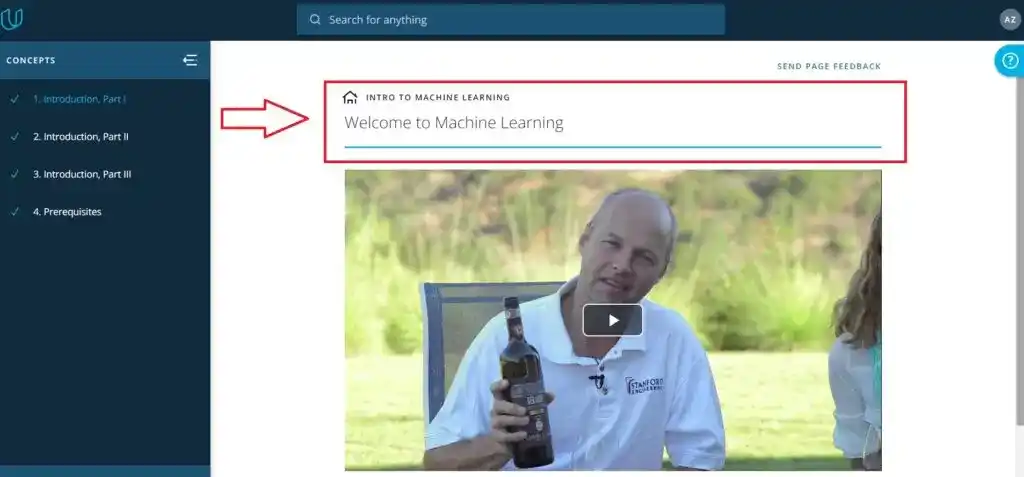
This first course gives you the machine learning foundation using AWS SageMaker. It covers the full ML workflow, from data preparation through deploying models.
I found this course easy, since I already had the ML background. You learn exploratory data analysis in SageMaker Studio, pulling datasets from S3, doing feature engineering with Data Wrangler and pandas, and labeling new data with SageMaker Ground Truth. Then it covers ML concepts proper. ML lifecycles, supervised versus unsupervised learning, regression and classification methods.
After that you build a full model deployment workflow with scikit-learn, evaluate it, and tune its hyperparameters. The course also covers the algorithms and tools you’ll lean on: linear models, tree-based models, XGBoost, AutoGluon, and SageMaker JumpStart.
Project: Predict Bike Sharing Demand with AutoGluon
This was an easy first project for me, nothing too complex. I pulled the Bike Sharing Demand dataset from Kaggle and trained a model using AutoGluon. Then Udacity had us submit the optimized model for a public Kaggle rank and write a report on our findings. The reviewer was helpful and gave me feedback to improve my code.
Course 2- Developing Your First ML Workflow (15 hours)
This course taught me how to build an ML workflow on AWS. It wasn’t too complex either. You learn the fundamentals of SageMaker for training, deploying, and evaluating a model, plus the essential services like training jobs, endpoints, batch transforms, and processing jobs. Then it gets into designing actual workflows with Lambda and Step Functions, and monitoring those workflows once they’re running.
The instructors here were engaging and explained each topic clearly. Joseph Nicolls, Charles Landau, and Soham Chatterjee walked through the tools, including Lambda and Step Functions.
Project: Build an ML Workflow for Scones Unlimited on Amazon SageMaker.
This project builds on the course concepts, so it wasn’t too hard. You build and ship an image classification model with SageMaker for “Scones Unlimited,” a scone-delivery company, and wire it together with Lambda and Step Functions into an end-to-end workflow. My mentor guided me through the tricky parts, and with his help I finished it on time and submitted it for review.
Course 3- Deep Learning Topics with Computer Vision and NLP (15 hours)
This course covers deep learning, and it’s where things got more advanced. I had the basics from my Udemy course, so I had a starting point. But this went deeper. You learn how to train, finetune, and deploy deep learning models on SageMaker.
It starts with neural network fundamentals, cost functions, optimization, and how to train a network. Then it moves into advanced architectures like convolutional neural networks and BERT, and how to finetune them for specific tasks. The main focus is on CNNs and computer vision, and the project reflects that. Finally you take everything and do it inside SageMaker Studio.
Project: Image Classification using AWS SageMaker.
Here I finetuned a pretrained model and ran image classification using SageMaker. I picked up some useful practices along the way, like SageMaker profiling, the debugger, and hyperparameter tuning. I’ll be honest, I hit some difficulties on this one and had to resubmit it twice before it got approved. But that struggle is part of why the concepts stuck.
Course 4- Operationalizing Machine Learning on SageMaker (18 hours)
This was the toughest course for me, and also one of the most valuable. It covers the advanced side of deploying professional ML projects on SageMaker. How to maximize output while cutting costs, how to deploy projects that handle high traffic, how to work with very large datasets, and how to think about security in ML applications on AWS.
You learn to manage compute resources efficiently to keep costs down, train models on large-scale datasets using distributed training, build pipelines for high throughput and low latency (basically preparing your project for heavy traffic with minimal delay), and design secure ML projects. This is real production-engineering content, and it’s exactly the operational skill set that separates an ML engineer from someone who only trains models in a notebook.
Project: Operationalizing an AWS ML Project.
In this project you take a model and prepare it for production-grade deployment, adjusting and configuring it with the right AWS tools. You handle cost minimization, security, and redeployment on a separate server. I took a little extra time on this one for personal reasons, but it taught me the full deployment procedure end to end.
Course 5: Capstone, Build Your Own Machine Learning Portfolio (28 hours)
The program ends with a capstone where you solve a real-world problem using everything you learned. First you submit a project proposal. Once it’s approved, you build the project out.
Project: Inventory Monitoring at Distribution Centers.
For my capstone I used the Amazon Bin Image Dataset and built a model to count the number of objects in each bin. You’re free to choose your own model type and architecture, but you have to train it using SageMaker. This was a time-taking project.
Two tips from my own experience here. First, when you upload the dataset, make sure it goes to the correct S3 bucket using the AWS S3 CLI or the S3 UI. I uploaded mine to the wrong bucket and got confused, then had to redo it. Second, after you finish the standout suggestions, write a clear README explaining what you did and how. The README is the last step, and a detailed one makes it much easier for reviewers to understand your work and give you good feedback.
The thing I appreciated most about this Nanodegree is the rhythm. They teach the concepts first, then hand you a project to test your understanding. Sometimes I got stuck and felt irritated. But that learn-then-build method is exactly what made the concepts click.
What Changed Since I First Took It
When I originally did this program, it was structured as 4 courses and 5 projects. Udacity has since rebuilt it with AWS into the current 7-course, 6-project format, with more depth on operationalizing ML and a dedicated capstone proposal step. The big shift is how AWS-centric it is now. Nearly everything runs through SageMaker. If you specifically want to learn AWS-based ML deployment, that’s a plus. If you wanted cloud-agnostic ML theory, know that this program is firmly built around the AWS stack.
How Much Does the AWS Machine Learning Engineer Nanodegree Cost?
Udacity estimates about 5 months at 5 to 10 hours a week. It runs on a subscription, around $399 a month, with the option to pay several months upfront. At the standard pace, the total usually comes to more than $800, though it depends on how fast you finish and what discount you get.
I’ll be straight about this. At full price, I don’t think this Nanodegree is worth it, because you can find ML theory cheaper on Coursera or Udemy. But the AWS deployment focus and the mentor-reviewed projects are things those cheaper courses don’t give you. So my honest take is this: get it at a discount or through a scholarship, and then it’s worth it.
Because billing is monthly, finishing faster directly lowers your cost. Reading each project’s rubric before you start the lessons helped me move quicker and avoid rewatching videos.
How to Get the Udacity AWS Machine Learning Scholarship
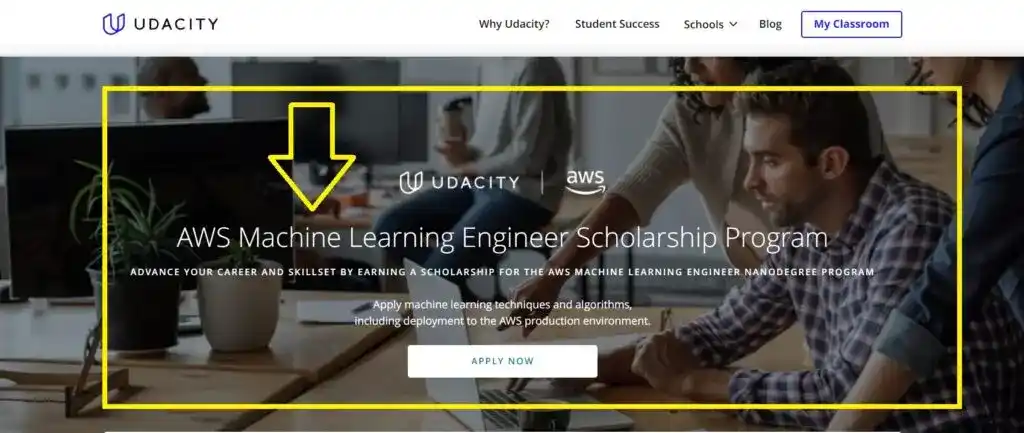
Udacity runs an AWS Machine Learning scholarship, and it’s worth applying for given the cost. Visit the scholarship page and click “Apply Now.” You’ll fill in background information (country, age, education, current role, experience, and weekly hours you can commit), a prerequisite-knowledge section that varies by program, and a goals section.
The goals section is the one that matters most. You explain your main reason for joining, what you hope to accomplish, and why you should get the scholarship. Fill that part out carefully, because it’s what improves your chances. Submit, and if you’re selected you’ll hear by email.
What I Liked About the Program
- The course structure was well organized, and the order of topics made sense.
- All the instructors were experienced and explained things clearly. The teaching method was the real strength: they cover the concepts, then give you a project, and those projects are what made the ideas stick.
- The technical mentor support was excellent, and I hadn’t found that on other platforms. Whenever I got stuck, my mentor cleared my doubts.
- The review system was strong too.
- A reviewer checked my code personally and gave feedback based on how it actually performed. And across the whole program I picked up advanced, production-focused ML skills.
What I Didn’t Like
- Udacity still has no iOS or Android app, so watching videos on my phone was awkward.
- The program also doesn’t teach the basics of ML algorithms.
- You’re expected to already understand linear regression, logistic regression, and neural networks coming in.
- And it doesn’t cover Python basics either. So if you’re a beginner, you’ll feel lost. These aren’t flaws exactly, they’re just the reality of an intermediate program, but you should know them before you pay.
Is the Udacity AWS Machine Learning Engineer Nanodegree Worth It?
Yes, for intermediate learners, not for beginners. If you already know Python and ML algorithms and want to advance into AWS-based model deployment, this Nanodegree is worth it. You learn the concepts by building real projects on SageMaker. But if you’re a beginner, don’t enroll without first learning Python and machine learning.
My Verdict: Worth It With Prerequisites and a Discount
If you know Python and ML basics and want to learn AWS SageMaker deployment through real, reviewed projects, this Nanodegree delivers, especially at a discount. If you’re a beginner, build your foundations first.
My Honest Suggestion Before You Enroll
The biggest misunderstanding I see is people thinking they’ll walk into a “Machine Learning Engineer” job the moment they finish this Nanodegree. That’s not how it works, and I’d rather tell you now.
This Nanodegree helps you learn the concepts and gives you a few solid projects. That’s it. After you finish, keep building. Work on more projects, strengthen your portfolio, put your work on GitHub. That’s what actually gets you the job. The Nanodegree is a launch point, not the finish line.
What Should Beginners Do Instead?
If you’re a beginner, don’t start here. Build your foundations first.
Machine Learning A-Z™ (Udemy) is a solid, cheap starting point for the basics of ML algorithms in Python and R. It’s the one I started with.
Machine Learning by Andrew Ng (Coursera) is the classic foundation for the theory behind ML.
Programming for Data Science with Python (Udacity) is the right pick if you need to build the Python foundation first.
Once you’re comfortable with Python and core ML algorithms, come back to this Nanodegree for the AWS deployment side. For more options, see our guide to the best free machine learning and AI courses.
How This Compares to Other Udacity Programs
If you’re weighing Udacity’s AI and ML programs, here’s how they fit together.
The AWS Machine Learning Engineer Nanodegree (this one) is for people who already know ML and want to learn how to deploy and operationalize models on AWS SageMaker. It’s the production-and-deployment program.
The Data Scientist Nanodegree leans more toward analysis, modeling, and drawing insights from data rather than deploying models at scale. I cover it in my Data Science Nanodegree review.
The Generative AI and Agentic AI Nanodegrees are the better picks if you specifically want to work with large language models, RAG, and AI agents rather than classic ML deployment. I reviewed both: the Generative AI Nanodegree and the Agentic AI Nanodegree.
For complete beginners, Programming for Data Science with Python is the foundation to start from.
For most people asking which is the best Udacity Nanodegree, the answer depends on your goal. Want to deploy ML models on the cloud and earn ML engineer pay? This AWS program. Want analysis and modeling? Data Science. Want LLMs and agents? Generative or Agentic AI.
That’s all. It’s time to wrap up this Udacity AWS Machine Learning Engineer Nanodegree Review–
Conclusion
I hope this Udacity AWS Machine Learning Engineer Nanodegree Review helped you and cleared your doubts regarding the Udacity AWS Machine Learning Engineer Nanodegree Review program. If you have any doubts or questions, feel free to ask me in the comment section.
So, is the Udacity AWS Machine Learning Engineer Nanodegree worth it in 2026? For the right person, yes. If you already know Python and machine learning, this program teaches you the AWS SageMaker deployment and MLOps skills that employers pay a premium for, through real projects reviewed by mentors. It’s not for beginners, and at full price it’s expensive. But if you have the prerequisites, enroll during a discount, treat it as a launch point, and keep building after, it delivers real, career-relevant skills.
If you’re a beginner, start with one of the alternatives above and come back once you have the foundations.
I hope this review answers your question and helps you decide if the Nanodegree fits your skills, your goals, and your budget.
Ready to Decide?
You can explore the full curriculum, see all six projects, and check the latest pricing and discounts on Udacity’s official page.
All the Best!
Happy Learning!
FAQ
You May Also Be Interested In
Best Udacity Nanodegree for Machine learning You Should Enroll in 2026
Best Math Courses for Machine Learning- Find the Best One!
9 Best Tensorflow Courses & Certifications Online- Discover the Best One!
Machine Learning Engineer Career Path: Step by Step Complete Guide
Best Online Courses On Machine Learning You Must Know in 2026
Best Machine Learning Courses for Finance You Must Know
Best Resources to Learn Machine Learning Online in 2026
Thank YOU!
Learn Machine Learning A to Z Basics
Though of the Day…
‘ Anyone who stops learning is old, whether at twenty or eighty. Anyone who keeps learning stays young.
– Henry Ford

Written By Aqsa Zafar
Aqsa Zafar is a Ph.D. scholar in Machine Learning at Dayananda Sagar University, specializing in Natural Language Processing and Deep Learning. She has published research in AI applications for mental health and actively shares insights on data science, machine learning, and generative AI through MLTUT. With a strong background in computer science (B.Tech and M.Tech), Aqsa combines academic expertise with practical experience to help learners and professionals understand and apply AI in real-world scenarios.