
Are you looking for “What is AutoML in Machine Learning?” When I first started with machine learning, I realized how much work happens behind the scenes before you even see a useful model. Data cleaning, feature engineering, picking the right algorithm, parameter tuning, it’s not only time-consuming but also pretty intimidating for beginners. Even today, with all the new AI tools around, this challenge hasn’t gone away.
That’s where AutoML (Automated Machine Learning) steps in. I remember trying it on one of my early projects, and it genuinely felt like a shortcut through the most repetitive parts of ML. AutoML doesn’t replace human expertise, but it helps you move faster by automating many of the tedious steps. This is especially important right now, when the field of AI is moving quickly, and people want to focus on applying machine learning rather than just setting it up.
In this blog, I’ll break down what AutoML is, why it exists, and how it works in practice. I’ll also share where it can make a real difference—and just as importantly, its limitations. Because in today’s AI world, it’s easy to get caught up in hype, but understanding both the strengths and weaknesses of AutoML will help you use it wisely.
What is AutoML in Machine Learning?
- What is AutoML? (A Simple Definition)
- Why AutoML Exists (The Problem It Solves)
- How AutoML Works (Step by Step)
- Example: AutoML for Customer Churn Prediction
- Popular AutoML Tools You Should Know
- Benefits of AutoML (With Real-World Relevance)
- Real-World Example
- Limitations of AutoML (An Honest View)
- The Balanced View
- Who Should Use AutoML?
- Who Should Avoid AutoML?
- Real-Life Use Cases of AutoML
- My Personal Take on AutoML
- What Industry Leaders Say
- What Research Says About AutoML
- Comparing Popular AutoML Tools
- How to Decide
- Conclusion
- FAQs
What is AutoML? (A Simple Definition)
At its core, Automated Machine Learning (AutoML) is about letting automation handle many of the repetitive steps involved in building a machine learning model. Normally, you’d have to spend hours cleaning data, testing different algorithms, adjusting parameters, and checking which model performs best. AutoML does a lot of this heavy lifting for you.
In simple terms, you can think of AutoML as a smart assistant for data science. Instead of you manually deciding, “Should I try Random Forest or XGBoost?” and then tuning both by hand, AutoML will run multiple models, fine-tune them, and show you which one gives the best results.
This doesn’t mean you can skip understanding machine learning basics, but it does make the process faster, more consistent, and accessible, even if you’re not a coding expert. For professionals, it saves time; for beginners, it lowers the entry barrier.
Why AutoML Exists (The Problem It Solves)
Traditional machine learning, while powerful, comes with two major hurdles:
- It’s time-consuming and technical. Data scientists often spend days, or even weeks, just cleaning data, tuning parameters, and testing models.
- It demands deep expertise. Building a complete ML pipeline isn’t something most people without a technical background can easily do.
This is where AutoML makes a difference. By automating many of these steps, it lowers the barrier to entry. A student, business analyst, or small startup can experiment with machine learning and still get valuable results without needing to be an expert coder.
For professionals, AutoML doesn’t replace their skills; it enhances them. Instead of being stuck in endless trial-and-error, data scientists can move faster, test more ideas, and spend more time on higher-value work like interpreting results and shaping strategy.
How AutoML Works (Step by Step)
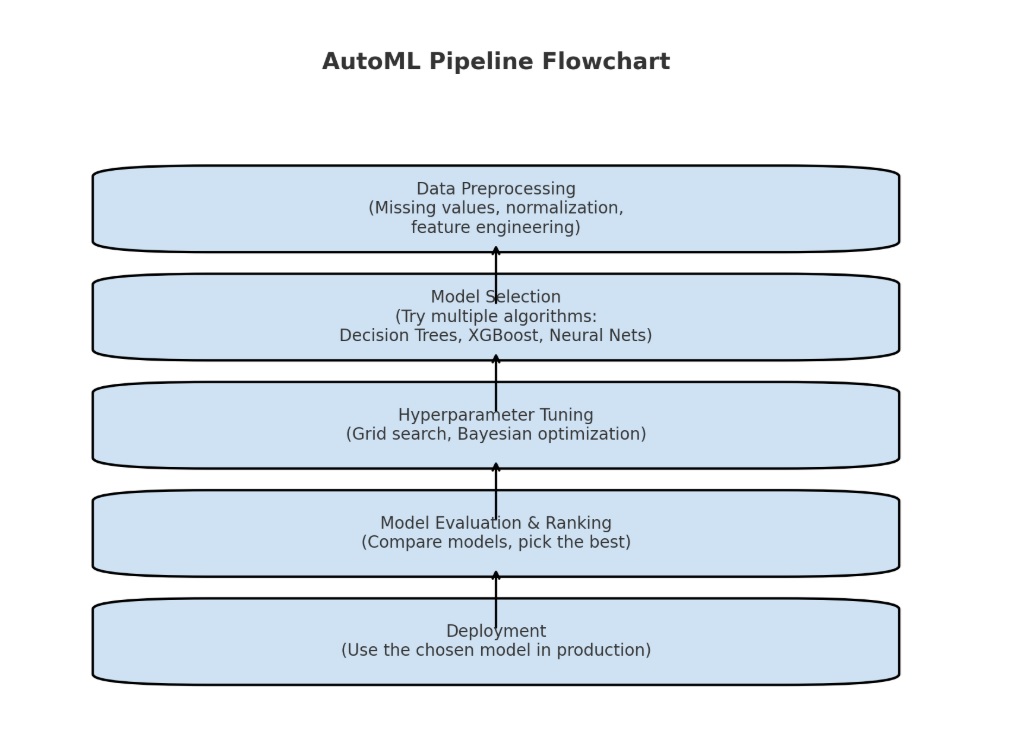
Different AutoML tools may look slightly different on the surface, but most of them follow a similar process. Here’s a breakdown of what typically happens under the hood:
1. Data Preprocessing
Before any model is built, the data has to be prepared. AutoML tools automatically:
- Handle missing values (e.g., filling them in or removing incomplete rows).
- Normalize or scale numerical features so algorithms can process them effectively.
- Create or transform features (known as feature engineering), which can significantly improve model performance.
For many beginners, this step alone saves hours of frustration because messy datasets are the norm in real projects.
2. Model Selection
Instead of you picking just one algorithm, AutoML will try several, such as Decision Trees, Random Forests, Gradient Boosted Models, or even Neural Networks.
- The goal here isn’t to guess which one is “best” ahead of time.
- AutoML systematically tests a variety of models to see which fits your data best.
3. Hyperparameter Tuning
Every algorithm comes with settings (hyperparameters) that affect how it learns. For example, how deep should a decision tree grow? How many neurons should a neural network layer have?
- AutoML uses techniques like grid search, random search, or more advanced methods like Bayesian optimization to find the best combination.
- This tuning can make the difference between an average model and a high-performing one.
4. Evaluation and Ranking
Once models are trained, AutoML evaluates them using performance metrics (like accuracy, precision, recall, F1-score, or AUC—depending on the problem).
- Models are ranked so you can clearly see which one performed best.
- Some platforms also provide explanations or visualizations, helping you understand why a model works well.
Example: AutoML for Customer Churn Prediction
Imagine a telecom company wants to predict which customers are likely to leave (churn) so they can take preventive action. Here’s how AutoML would handle it:
- Data Preprocessing:
The company provides a dataset with customer demographics, monthly bills, call records, and contract types. AutoML cleans missing data (like missing payment info), normalizes billing amounts, and encodes text fields like “Yes/No” into usable numeric features. - Model Selection:
AutoML tests different models, Logistic Regression, Random Forest, Gradient Boosted Trees, and Neural Networks, to see which one handles the churn data best. - Hyperparameter Tuning:
For models like Random Forest, AutoML tunes parameters such as the number of trees or the depth of each tree. For Neural Networks, it adjusts the number of layers and the learning rate. - Evaluation and Ranking:
AutoML compares models based on AUC (a good metric for churn prediction). Suppose Gradient Boosted Trees perform best with an AUC of 0.91. That model is ranked at the top.
The company now has a high-quality churn prediction model without spending weeks manually building and testing everything.
In short, AutoML works like an “auto-pilot” for the ML workflow. It doesn’t replace human expertise, but it gives you a strong, data-backed starting point. From there, you can fine-tune further or directly apply the results to solve real business problems.
Popular AutoML Tools You Should Know
AutoML has grown a lot in recent years, and there’s no shortage of tools to choose from. Some are built for enterprises with large-scale data needs, while others are open-source and beginner-friendly. Choosing the right one really depends on your background, resources, and goals.
1. Cloud-Based AutoML Platforms
These are great if you’re working with large datasets, need scalability, or want a “plug-and-play” experience without worrying about infrastructure.
- Google Cloud AutoML – Part of Google’s Vertex AI suite, it’s user-friendly and strong for tasks like image recognition, natural language processing, and tabular data.
- AWS SageMaker Autopilot – A solid option if you’re already in the AWS ecosystem. It automatically preprocesses data, tests algorithms, and explains the chosen model.
- Microsoft Azure AutoML – Offers both a code-first and no-code experience. A good fit for businesses already using Microsoft tools.
These platforms are powerful, but keep in mind they’re paid services. They make sense if you’re dealing with real-world production data or if your organization already uses these cloud providers.
2. Open-Source AutoML Tools
If you’re just getting started, open-source AutoML libraries are the best way to experiment without spending money. They run locally and give you more flexibility.
- Auto-sklearn – Built on top of scikit-learn, it’s great for beginners who already know Python. It automatically tests models and tunes hyperparameters.
- H2O AutoML – A very popular library with strong community support. It works well for both small experiments and larger-scale problems.
- TPOT – Uses genetic programming to find the best ML pipelines. It’s slower than others but can discover creative model combinations.
- MLJAR – Focused on simplicity. It’s beginner-friendly and comes with useful reporting features.
For students, hobbyists, or anyone new to machine learning, I’d recommend starting with Auto-sklearn or H2O AutoML. They’re free, fairly easy to set up, and will give you hands-on experience with how AutoML actually works.
Even if you use AutoML, it’s valuable to understand the basics of how models work. Tools can speed things up, but having foundational knowledge helps you interpret results and avoid common pitfalls.
Benefits of AutoML (With Real-World Relevance)
AutoML isn’t just about making machine learning “easier”, it solves real challenges faced by students, researchers, and businesses alike. Here are some of the biggest benefits, with examples to show how they apply in practice:
1. Saves Time on Repetitive Work
Much of traditional ML involves trial-and-error—testing algorithms, tuning hyperparameters, and re-running experiments. AutoML automates these steps, which means what used to take weeks can sometimes be done in hours.
- Why it matters: In fast-moving industries, quicker results often mean staying ahead of competitors.
2. Accessible to Non-Experts
Not everyone building models is a professional data scientist. AutoML lowers the barrier so business analysts, students, or small startups can build models without deep technical knowledge.
- Why it matters: This democratizes AI, making it useful beyond just tech-heavy organizations.
3. Faster Prototyping for Data Scientists
Even for professionals, AutoML is a productivity tool. Data scientists often use it to generate a strong baseline model quickly. From there, they can decide whether to stick with AutoML’s results or develop a custom solution.
- Why it matters: It frees up experts to focus on strategy, interpretation, and improving business outcomes rather than repetitive coding.
4. Scalable for Enterprises
For organizations, AutoML makes deploying machine learning models much faster. Instead of long R&D cycles, teams can build, test, and deploy models at scale with fewer resources.
- Why it matters: This allows companies to integrate ML into real-world systems without hiring massive engineering teams.
Real-World Example
Imagine a healthcare startup trying to predict which patients are most at risk of being readmitted to the hospital. Hiring a full data science team would be expensive and slow. With AutoML, they can feed in their patient data, quickly build predictive models, and use the insights to improve patient care. In this case, AutoML helps the startup act faster while still producing reliable results.
AutoML isn’t just about convenience, it’s about unlocking machine learning for more people and making AI adoption realistic for businesses of all sizes.
Limitations of AutoML (An Honest View)
Like any technology, AutoML isn’t perfect. It can be a powerful ally, but it’s important to know its limits so you don’t treat it as a “magic button.” Here are some of the main challenges:
1. Limited Explainability
AutoML may deliver a high-performing model, but understanding why it works the way it does isn’t always straightforward. Some tools provide feature importance charts or explanations, but the depth of interpretability is often less than what you’d get by building and tweaking the model yourself.
- Why it matters: In fields like healthcare or finance, being able to justify a model’s decisions is as important as its accuracy.
2. Not Always the Best Choice for Complex Problems
AutoML is excellent for general tasks, but when problems are highly domain-specific or unusually complex, handcrafted models can still outperform automated pipelines.
- Why it matters: For cutting-edge research or specialized use cases, data scientists often need full control over the algorithms and features.
3. Cost on Cloud Platforms
While open-source AutoML tools are free, cloud-based AutoML can become expensive if you’re training on very large datasets or running many experiments.
- Why it matters: Startups and students should be mindful of costs, as AutoML cloud jobs can quickly add up.
4. Still Requires Domain Knowledge
AutoML won’t fix bad data. If your dataset is irrelevant, biased, or collected poorly, the results will still be unreliable. Human understanding of the domain is crucial for asking the right questions and making sense of the outputs.
- Why it matters: Automation reduces technical effort, but it doesn’t replace human judgment.
The Balanced View
AutoML is a powerful tool, but it’s not a replacement for data science expertise. Think of it as a productivity booster rather than a complete solution. When used wisely—paired with human insight and domain knowledge—it can save huge amounts of time and open the door to new opportunities. But like any tool, knowing its boundaries is what makes it truly valuable.
Who Should Use AutoML?
AutoML isn’t a one-size-fits-all solution. Its value depends on who’s using it and what they’re trying to achieve. Here are some practical scenarios where AutoML makes sense:
1. Beginners and Students
If you’re curious about machine learning but don’t have strong coding or math skills yet, AutoML can be a great entry point.
- How it helps: You can focus on understanding the concepts—like how models are evaluated or why one algorithm outperforms another—without getting stuck on the technical details of writing every line of code.
- Why it matters: This lowers the intimidation barrier and builds confidence, especially for learners exploring AI for the first time.
2. Professional Data Scientists
For experienced practitioners, AutoML isn’t a replacement for their skills—it’s a time-saver.
- How it helps: Data scientists often use AutoML to quickly generate a baseline model. Once they know what works reasonably well, they can decide whether to refine it with custom feature engineering, deep learning, or domain-specific tweaks.
- Why it matters: It speeds up the experimentation process, leaving more room for critical tasks like interpreting results and aligning them with business goals.
3. Businesses and Startups
Not every company has the resources to hire a large, specialized data science team. AutoML gives smaller teams a way to integrate machine learning into their operations without building everything from scratch.
- How it helps: A marketing team could predict customer churn, a healthcare startup could identify at-risk patients, or a retailer could forecast demand—all without hiring a full ML engineering staff.
- Why it matters: AutoML democratizes access to AI, making it feasible for businesses of all sizes to compete with data-driven strategies.
Who Should Avoid AutoML?
While AutoML is powerful, it’s not the right fit for everyone. In some cases, relying on it could even backfire:
1. Researchers Pushing the Boundaries of AI
If you’re developing new algorithms, architectures, or optimization techniques, AutoML won’t help much.
- Why: AutoML is designed to automate existing approaches, not invent new ones. Researchers need full control over every detail of the pipeline.
2. Companies with Highly Sensitive or Regulated Data
Industries like healthcare, finance, or government often need full explainability and compliance.
- Why: AutoML sometimes sacrifices transparency for speed. If you can’t clearly explain how your model works, you could run into legal, ethical, or compliance risks.
3. Domain-Specific or Extremely Complex Problems
Some problems require deep domain knowledge—like drug discovery, climate modeling, or natural language understanding.
- Why: AutoML may produce a decent model, but handcrafted solutions tailored by experts often perform better in these specialized areas.
AutoML is best seen as a bridge. For beginners, it’s a way to enter the world of machine learning. For professionals, it’s a tool to accelerate workflows. And for businesses, it’s a chance to adopt AI without massive upfront investment. But if you’re working on cutting-edge research, handling sensitive data, or tackling highly complex problems, AutoML alone won’t be enough—you’ll need human expertise at the center.
Real-Life Use Cases of AutoML
AutoML isn’t just an academic concept—it’s already being applied in industries where speed, accuracy, and scalability matter. Here are some practical examples:
1. Fraud Detection in Finance
Banks and fintech companies process millions of transactions every day. Manually building models to catch fraudulent activity would take too long and need constant retraining.
- How AutoML helps: It automatically tests different models, fine-tunes parameters, and updates predictions as new data flows in.
- Real-world impact: This allows financial institutions to flag suspicious transactions in real time, reducing fraud losses and protecting customers.
2. Customer Churn Prediction in Business
Every business worries about losing customers, but identifying who might leave isn’t easy. Traditional analytics often miss subtle patterns.
- How AutoML helps: By analyzing customer history, purchase frequency, or support interactions, AutoML can build predictive models without requiring a large data science team.
- Real-world impact: A telecom company, for example, can proactively offer discounts or better plans to customers flagged as “high churn risk.”
3. Healthcare and Medical Imaging
Doctors and hospitals generate massive amounts of medical data—X-rays, MRIs, and patient records. Building custom models for each condition is both costly and time-consuming.
- How AutoML helps: It automates preprocessing, model testing, and tuning for diagnostic tasks like detecting tumors or predicting patient readmissions.
- Real-world impact: A small healthcare startup could use AutoML to assist radiologists in diagnosing diseases faster, especially in regions with limited medical staff.
4. Recommendation Systems in E-Commerce
E-commerce platforms thrive on personalization, but creating an effective recommendation engine requires testing multiple models and approaches.
- How AutoML helps: AutoML can automatically evaluate collaborative filtering, content-based filtering, and hybrid models to find the best fit.
- Real-world impact: Shoppers see more relevant product suggestions, which improves their experience and increases sales for the platform.
My Personal Take on AutoML
From my experience in machine learning, I’d describe AutoML as a very capable assistant, but not a substitute for human expertise.
On the positive side, AutoML shines in areas like:
- Prototyping: When I want to test an idea quickly, AutoML helps me get a working baseline without spending hours on feature engineering or parameter tuning.
- Education: For students or beginners, it’s an excellent way to understand the workflow of ML without getting stuck on technical barriers right away.
- Accessibility: I’ve seen non-technical teams—like business analysts or healthcare staff—use AutoML to build useful models that would have otherwise been out of reach.
That said, I also see clear limits. In research or highly specialized projects, I prefer manual model-building. Why? Because I need control, explainability, and fine-grained optimization that AutoML tools don’t always provide. Sometimes, the best-performing model isn’t just about accuracy—it’s about transparency, fairness, or compliance with regulations, and those aspects require human oversight.
So, here’s my advice:
- If you’re just starting out → Definitely try AutoML. It will save you time, give you hands-on exposure, and build confidence.
- If you want to grow into a machine learning expert → Don’t stop at AutoML. Learn the fundamentals—data preprocessing, algorithms, model evaluation—because those skills will help you go beyond what automation can offer.
In short, AutoML is a powerful companion. It can accelerate your journey, but it shouldn’t replace your curiosity, critical thinking, or technical foundation. The real value comes from combining human judgment with automation.
What Industry Leaders Say
Industry-leading cloud providers have developed mature AutoML solutions, and their official resources reflect how trusted and practical these tools have become:
Google Cloud AutoML Vision
On the Google Cloud AI blog, you’ll find an example of how AutoML Vision helps power breast cancer detection by guiding developers through a codelab to train, deploy, and run inference on medical imaging data. It’s a strong illustration that even critical healthcare workloads—like radiology—can benefit from AutoML tools.
Read more: Unlocking what’s possible with medical imaging data in the cloud
AWS SageMaker Autopilot
Amazon emphasizes the importance of explainable AutoML, especially for enterprise use. The SageMaker Autopilot service integrates with SageMaker Clarify, which uses techniques like SHAP (Shapley Additive Explanations) to show which features contribute to a model’s decisions—helping with compliance, trust, and transparency.
Learn more: SageMaker Clarify explainability documentation
Microsoft Azure AutoML
Azure’s AutoML tools are tightly integrated into the broader Azure ecosystem, supporting both no-code and code-first experiences and enabling full ML workflows—from training to deployment and monitoring. This seamless integration makes it easier for organizations already invested in Azure to include machine learning in their operations.
Explore: Automated ML in Azure Machine Learning
These examples show that AutoML isn’t just a novelty; it’s a well-supported, enterprise-ready offering. Google demonstrates its use in sensitive fields like medical imaging; AWS focuses on transparency and trust; and Microsoft emphasizes integration and deployment at scale. Together, they signal that AutoML is not hype, it’s a practical, evolving solution trusted by global technology leaders.
What Research Says About AutoML
AutoML isn’t just being talked about in tech blogs, it’s also a serious topic in academic research. And the message from researchers is clear: AutoML makes machine learning more accessible, but it still needs human judgment to be used responsibly.
Making AI More Accessible
A 2024 review pulled together dozens of studies and industry reports to see how AutoML is actually being used in practice. The conclusion? AutoML takes care of time-consuming tasks like feature engineering, model selection, and tuning, which means smaller teams and non-experts can now build ML models that used to require specialists. But the authors also stress that AutoML should be seen as a way to support human decision-making—not replace it.
The Beginner’s Perspective
Another study called A Neophyte With AutoML looked at how beginners interact with these tools. The researchers found that while AutoML lowers barriers, the user experience matters a lot. Some beginners were able to get results quickly, while others struggled because the tools weren’t always intuitive. This shows that while AutoML is powerful, it still needs to be designed with the end user in mind.
Why Humans Still Matter
A 2020 paper titled AutoML to Date and Beyond makes a strong point: automation helps with efficiency, but the hardest parts of machine learning—like framing the problem correctly, labeling good data, and interpreting outcomes—still require humans. In other words, AutoML can speed things up, but it can’t tell you if you’re solving the right problem.
The Fairness Question
Finally, there’s the issue of ethics. A 2023 study asked: Can fairness be automated? The answer was “not fully.” AutoML can include fairness-aware techniques, but bias and ethical choices can’t be left to algorithms alone. Humans still need to step in, especially when decisions affect people’s lives.
What I take away from this research is a balanced view: AutoML is a huge step forward in making machine learning easier to use, but it’s not a “set-and-forget” tool. The best results come when automation is combined with human expertise, oversight, and ethical responsibility.
Comparing Popular AutoML Tools
Not all AutoML platforms are created equal. Some are designed for enterprises with large budgets and cloud infrastructure, while others are open-source projects that you can run on your laptop for free. Choosing the right tool depends on your goals, level of expertise, and resources.
Here’s a practical comparison of a few widely used options:
| Tool | Type | Best For | Strengths | Limitations |
|---|---|---|---|---|
| Google Cloud AutoML | Cloud-based | Enterprises, image/NLP applications | Intuitive interface, integrates well with Google ecosystem (BigQuery, Vertex AI), strong support for vision and language tasks | Can become expensive with large datasets; requires cloud setup and billing |
| H2O AutoML | Open-source | Beginners, data scientists, small teams | Free to use, supports a wide variety of algorithms, good documentation, strong community support | Requires some coding knowledge (Python/R); not as polished as cloud UIs |
| Auto-sklearn | Open-source | Python users, research projects | Strong academic foundation, works well for structured/tabular data, built on top of scikit-learn | Focused mostly on tabular data; less suitable for images or text-heavy tasks |
How to Decide
- If you’re just starting out → Try H2O AutoML. It’s free, widely used in both industry and academia, and gives you a feel for how AutoML works without worrying about cloud costs.
- If you’re a researcher or Python enthusiast → Auto-sklearn is a great option. It has a strong academic foundation and integrates seamlessly into Python workflows.
- If you’re part of an enterprise or need scale → Google Cloud AutoML is a better fit. Its integrations with the broader Google Cloud ecosystem make it powerful for production use, though you’ll want to keep an eye on costs.
Start with an open-source tool if you’re experimenting or learning, and move to cloud-based AutoML when you need scalability, enterprise integration, or advanced features like NLP and computer vision.
Conclusion
AutoML is changing the way people approach machine learning. Instead of spending weeks writing code and tuning models, you can get something working in hours. That’s why it’s so valuable for beginners who want to learn, for businesses that need quick insights, and even for data scientists who just want a fast baseline to build on.
But let’s keep it real, AutoML isn’t a silver bullet. It works best for common, well-defined problems like predicting churn or detecting fraud. When the task is more complex or high-stakes, like medical diagnosis or cutting-edge research, you still need the depth, control, and judgment that only hands-on model-building and domain expertise provide.
If you’re curious, don’t just read about AutoML, try it yourself. Start with a free, open-source tool like Auto-sklearn or H2O, run it on a dataset you understand, and see what it produces. That simple experiment will teach you far more than theory alone.
For me, the way to think about AutoML is this: it’s a really helpful assistant. It can save you time, open doors, and make ML more approachable. But the real breakthroughs still come when you pair automation with human insight, creativity, and critical thinking.
FAQs
Also, Read
Best Math Courses for Machine Learning- Find the Best One!
9 Best Tensorflow Courses & Certifications Online- Discover the Best One!
Machine Learning Engineer Career Path: Step-by-Step Complete Guide
Best Online Courses On Machine Learning You Must Know in 2026
Best Machine Learning Courses for Finance You Must Know
Best Resources to Learn Machine Learning Online in 2026
Thank YOU!
Thought of the Day…
‘ Anyone who stops learning is old, whether at twenty or eighty. Anyone who keeps learning stays young.
– Henry Ford

Written By Aqsa Zafar
Aqsa Zafar is a Ph.D. scholar in Machine Learning at Dayananda Sagar University, specializing in Natural Language Processing and Deep Learning. She has published research in AI applications for mental health and actively shares insights on data science, machine learning, and generative AI through MLTUT. With a strong background in computer science (B.Tech and M.Tech), Aqsa combines academic expertise with practical experience to help learners and professionals understand and apply AI in real-world scenarios.