
Do you want to know about Udacity Nanodegree?… If yes, then read this article. In this article, I have shared everything about Udacity Nanodegree such as the Udacity Nanodegree Cost, Udacity Nanodegree Scholarship, Udacity Nanodegree Discounts, Pros, Cons, etc.
Udacity has changed significantly since most of the reviews you will find online were written. In May 2024, Accenture: one of the world’s largest consulting and technology firms: completed the acquisition of Udacity, integrating it into their LearnVantage platform. Since then, Udacity launched a fully accredited Master of Science in Artificial Intelligence (October 2025), an accredited MBA in AI Product Management (March 2026), added an AI chatbot powered by OpenAI for student support, and introduced new Nanodegree programs including the Azure Generative AI Engineer Nanodegree built with Microsoft.
This is a fundamentally different company than it was in 2022. The Nanodegree programs are the same model: project-based, industry-connected, human-reviewed: but the backing of Accenture’s enterprise client network and $1 billion LearnVantage investment changes what the credential means.
This guide covers everything you need to know about Udacity Nanodegrees in 2026: what they actually are, what they cost and how to pay less, how to get a scholarship, which programs are worth it, and the honest answer to whether a Nanodegree is worth the price.
Now, without further ado, let’s get started-
Udacity Nanodegree
- Udacity Nanodegree
- What is Udacity Nanodegree Program?
- What Does a Udacity Nanodegree Actually Include?
- How Much Does a Udacity Nanodegree Cost in 2026?
- Why Are Udacity Nanodegrees So Expensive?
- How to Save Money on Udacity Nanodegrees
- Udacity Nanodegree Complete List 2026
- New in 2026: Udacity's Accredited Degrees
- Is Udacity Nanodegree Worth It in 2026?
- Udacity vs Coursera: Which Is Better?
- How to Enroll in a Udacity Nanodegree: Step by Step
- Udacity Nanodegree Pros and Cons
- Udacity Nanodegree FAQ
- You May Also Be Interested In
- Though of the Day…
Let’s first understand What is Udacity Nanodegree Program?
What is Udacity Nanodegree Program?
A Udacity Nanodegree is a project-based online certification program designed to teach job-ready technical skills in areas like Artificial Intelligence, Data Science, Cloud Computing, Programming, Cybersecurity, and Business Analytics. The name “Nanodegree” reflects the scope: it is more focused than a traditional degree, designed to develop a specific set of skills rather than broad academic coverage.
What genuinely differentiates Udacity Nanodegrees from most other online courses is the human review model. When you submit a project, a real practitioner: not an automated grader: reviews it, leaves line-level feedback, and either approves it or sends it back with specific guidance on what to improve. This cycle repeats until the project meets professional standards. It is slower than instant AI grading, but the quality of feedback is meaningfully better for building skills you can actually use in a job.
Most Nanodegree programs take between 2 and 6 months to complete at a pace of 10 to 20 hours per week. The structure in every program follows the same pattern: video lessons covering concepts and techniques, quizzes to check understanding after each section, and graded projects that apply what you have learned to real-world problems. The projects are what the certificate is actually based on.
Since the Accenture acquisition, Udacity has also integrated an AI-powered learning assistant that students can use to get quick answers while working through course content, reducing the friction of getting stuck and waiting for a mentor response on simpler questions.
→ Check current Udacity discount offers here
What Does a Udacity Nanodegree Actually Include?
This is where Udacity differs most significantly from Coursera, Udemy, and most other platforms. Here is what is included in every Nanodegree program:
Video lessons in 10-20 minute segments. Rather than long lectures, content is broken into focused segments covering one concept at a time. This format lets you pause, practice, and move at your own pace without losing context across a 90-minute lecture.
Quizzes after each lesson section. These are not generic tests. Udacity’s quizzes are designed around the specific concepts taught in each lesson, which makes them useful for confirming understanding rather than just checking recall. They are not the primary assessment mechanism but they prevent passive video watching.
Graded projects reviewed by expert mentors. This is the core of the Nanodegree model. Each project comes with a detailed rubric specifying exactly what “meets expectations” requires. A human reviewer gives specific, actionable feedback on your submission. If it does not meet the rubric, you revise and resubmit. This continues until you have genuinely produced professional-standard work.
Mentor support and student community. You can submit questions to mentors and participate in student discussion forums. The quality of mentor support varies by program, some programs have faster and more detailed responses than others. Checking recent student reviews for the specific program you are considering is worth doing before enrolling.
Career services included in all programs. Every Nanodegree includes resume review, cover letter review, LinkedIn profile review, and GitHub portfolio review. These are not optional add-ons, they are built into the program structure and available from day one of enrollment.
Udacity Nanodegree certificate on completion. To receive the certificate, you must pass all quizzes and submit all graded projects with a rating of “Meets Expectations” or above, and complete the capstone project where one exists. The certificate includes a link to verify it is genuine.
How Much Does a Udacity Nanodegree Cost in 2026?
Udacity’s pricing structure has evolved significantly. Here is the current breakdown:
Monthly subscription: approximately $249 to $399/month depending on the program. Most Nanodegrees in Data Science, AI, and Cloud Computing are at the higher end. Some shorter or less intensive programs are at $249/month. You pay month-to-month and cancel anytime.
Bundled subscription (fixed months): 15-20% discount off the monthly rate. Udacity offers bundled access for 4-month or 6-month periods paid upfront. If you are confident you can complete the program in that window, this is cheaper than paying month-to-month. The risk is that you are committed to that timeframe: if you need more time, you pay for additional months.
All-Access Subscription. Udacity now offers an all-access plan that gives you access to all 80+ Nanodegree programs rather than just one. This makes sense if you plan to take multiple programs or want to explore before committing to one track. Pricing for this plan varies: check the current rate on Udacity’s site as it changes.
Discounts up to 50-65%. Udacity runs regular promotions, and the discount is often substantial. The platform consistently offers a “personalized discount” through a brief questionnaire (more on this in the saving money section below). Many learners find up to 65% off available on Nanodegree and subscription plans, making the effective price significantly lower than the headline monthly rate.
New accredited degree programs: The Master of Science in AI (launched October 2025) and MBA in AI Product Management (launched March 2026) are priced under $5,000 total: approximately 90% more affordable than traditional programs, according to Udacity. These are accredited through Woolf University, recognized in 60+ countries, and allow completed Nanodegrees to count toward the degree through Recognition of Prior Learning.
Why Are Udacity Nanodegrees So Expensive?
Compared to Coursera ($49/month for most specializations) or Udemy ($10-15 per course during sales), Udacity is significantly more expensive. The reasons are specific:
Human project review costs money. Hiring practitioners to review code, data science projects, and engineering work, give line-level feedback, and respond to revisions takes more resources than automated grading. This is the primary cost driver and the primary value driver.
Mentor support is real-time. Having access to technical mentors who answer questions about your specific project, not generic forum answers, requires staffing.
Career services are included. Resume review, LinkedIn coaching, and GitHub feedback from human reviewers are not free to provide.
Industry partnerships are built into the curriculum. Nanodegrees are developed in partnership with companies like Google, AWS, NVIDIA, and Microsoft. The curriculum reflects current industry requirements rather than academic syllabi, and maintaining those relationships has value that shows up in the credential recognition.
Pricing for most Nanodegrees sits in the $249–$399/month range, which is genuinely expensive for an online learning platform. Whether it is worth it depends on how much you use the mentor support and project review features, learners who engage with those elements consistently report better outcomes than those who treat it like a video course.
How to Save Money on Udacity Nanodegrees
There are three legitimate ways to pay less. I have personally verified each of these works.
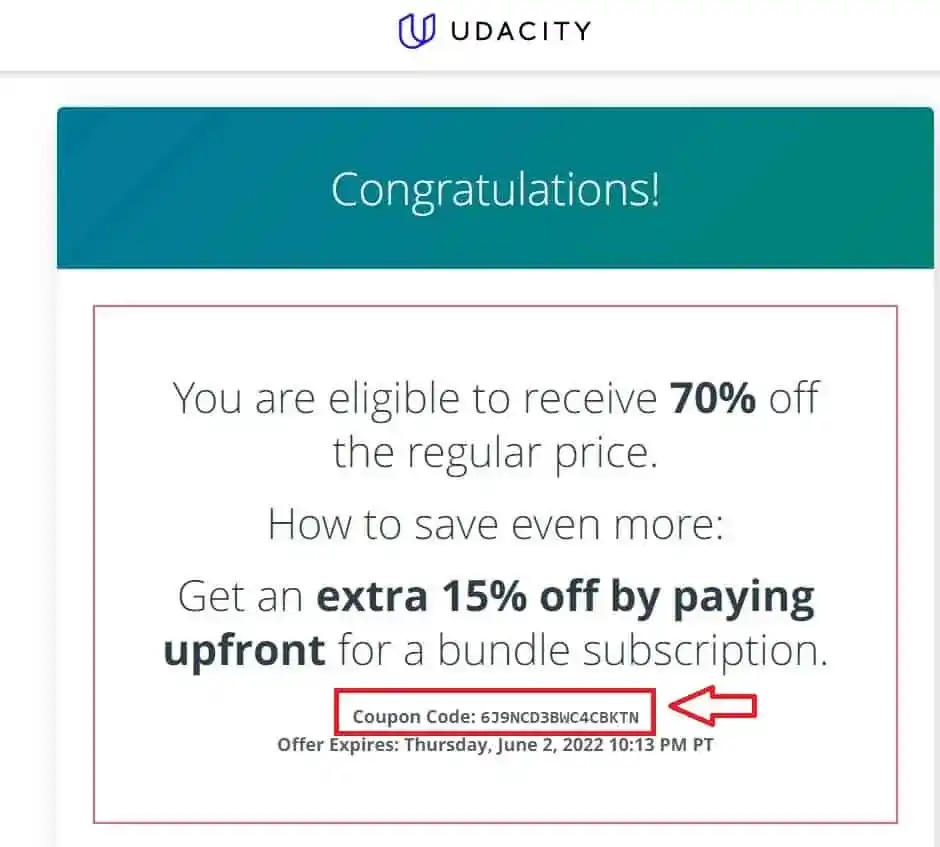
Method 1: Get a Personalized Discount
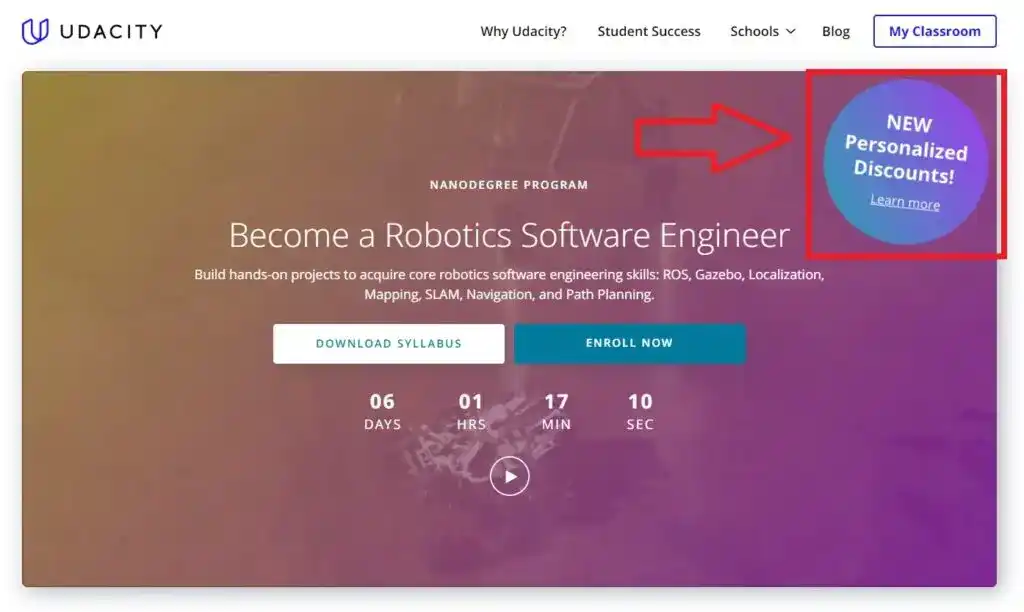
Udacity regularly offers personalized discount codes through a brief questionnaire on their site. When you see a “New Personalized Discount” option on the pricing page, click it.
You will be asked two questions about your learning goals and background. After submitting, you receive a unique coupon code. Apply this at checkout for a discount on your enrollment.
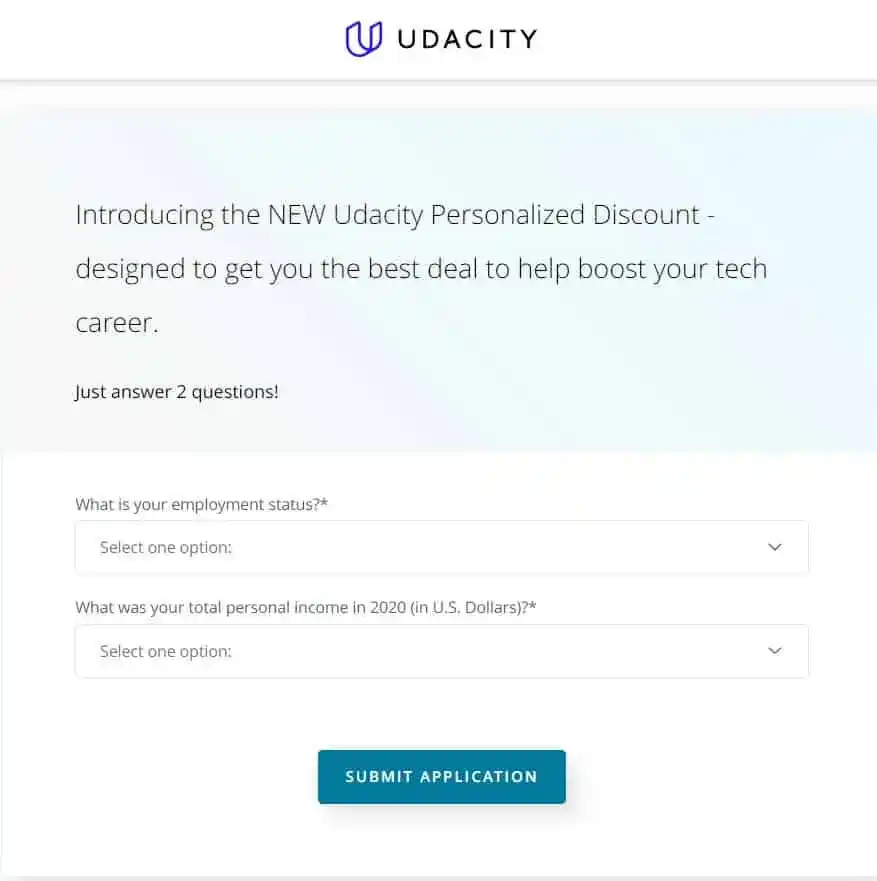
The discount amount varies but is often 30-50%. The important thing: this discount expires, so enroll within the validity window after receiving your code.
→ Check current Udacity discount offers here
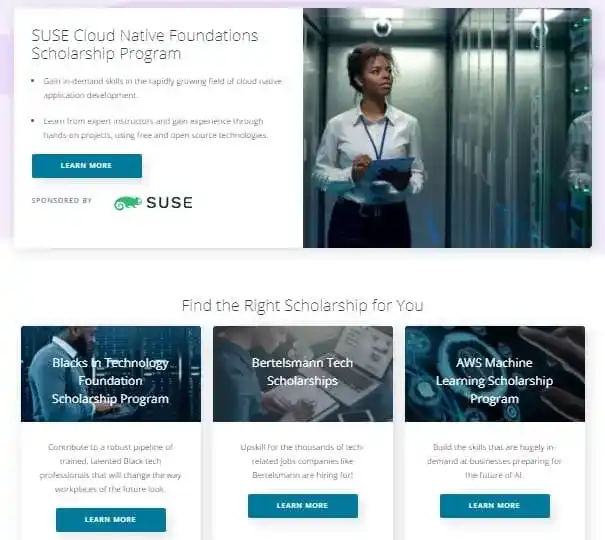
Method 2: Apply for a Udacity Scholarship
Udacity offers scholarships for many of its Nanodegree programs, particularly in AI, Data Science, and Cloud Computing. Scholarships can cover partial or full tuition costs.
→ Find Current Udacity Scholarships
The scholarship application process:
Go to Udacity’s scholarship page and find whether the program you want has a scholarship available. If it does, you complete an application covering four sections:
Background Information: your country, age, gender, education level, current job role, years of professional experience, and available hours per week for study.
Prerequisite Knowledge: this varies by program. For a Data Science Nanodegree, for example, you will be asked about your existing Python and statistics knowledge. Answer honestly, the scholarship is awarded to people who can genuinely benefit from and complete the program.
Your Goals: this is the most important section. You need to explain why you are applying for the scholarship, what you hope to accomplish, and why you should receive it. Be specific and genuine. Generic answers (“I want to advance my career”) are much less effective than specific ones (“I am a nurse who wants to understand the AI diagnostic tools entering my hospital, and the $399/month cost is beyond my current budget”).
Additional Questions: agreement to terms and conditions, and sometimes program-specific questions.
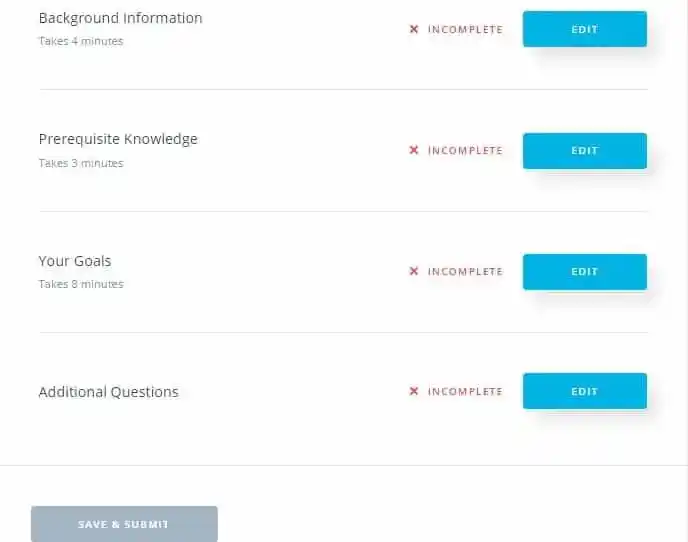
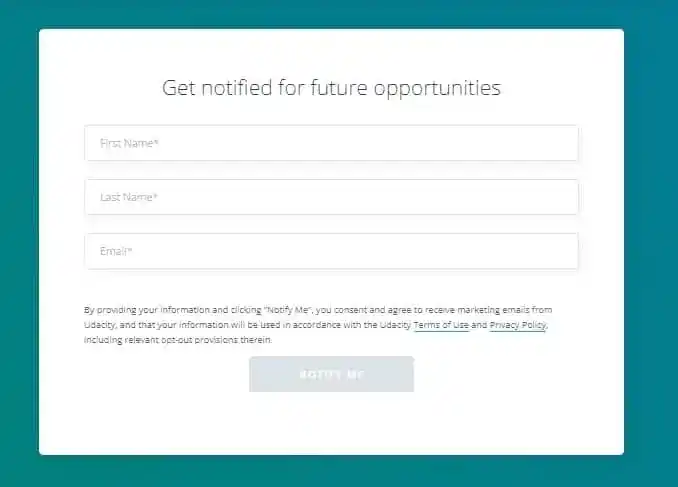
After submitting, Udacity reviews applications and notifies successful applicants by email. If your target program does not currently have a scholarship listed, you can submit your contact information to be notified when new scholarships open.
Method 3: Complete the Nanodegree Faster
Since Udacity charges monthly, finishing in fewer months directly reduces your total cost. A 5-month Nanodegree at $399/month costs $1,995. Completing it in 3 months costs $1,197: a saving of $798 with no discount code required.
This requires structured time management. The approaches that consistently work:
Read the project rubric before starting each module. The rubric defines exactly what your final project needs to demonstrate. Reading it first tells you which lectures and concepts are directly tested and which are supplementary. Take detailed notes on the high-priority content; skim the rest.
Start working on the project immediately after watching related lectures. Rather than watching all lectures then starting the project, implement each component right after learning it. This eliminates the need to re-watch content during the project phase.
Use the Pomodoro Technique for focused sessions. 25 minutes of focused work, 5-minute break, repeat. Most learners find this doubles their effective study time compared to open-ended sessions that drift toward passive watching.
Set a weekly milestone, not just a daily goal. Knowing you need to finish Module 3 by Sunday creates more accountability than “study for an hour today.”
Udacity Nanodegree Complete List 2026
Udacity now offers 80+ Nanodegree programs across 7 domains. Here is the current catalog organized by field:
→ Browse all Udacity Nanodegrees and check current pricing
New in 2026: Udacity’s Accredited Degrees
This is the most significant development in Udacity’s history and something no competing review blog has fully covered yet.
Master of Science in Artificial Intelligence (launched October 2025) Built with Woolf University, a Saïd Business School (University of Oxford) and Harvard Business Publishing education partner, this is a fully accredited MS in AI priced at approximately $4,995 total. It is 90% more affordable than traditional MS programs while being recognized across 60+ countries through the European Qualifications Framework. Over 1,500 learners enrolled in the inaugural cohort. The program leverages the same project-based instructional model as Nanodegrees.
MBA in AI Product Management (launched March 2026) A fully accredited MBA for AI product leaders, combining business fundamentals with applied AI project training. Designed for people who want to lead AI initiatives at the product strategy level rather than implement them technically.
The “Recognition of Prior Learning” feature is particularly significant for existing Udacity students. Completed Nanodegree programs can count toward the MS or MBA degree, potentially reducing the remaining work required to graduate. If you have already completed relevant Nanodegrees, the path to an accredited degree is shorter than starting from scratch.
Is Udacity Nanodegree Worth It in 2026?
This is the question that matters, and the honest answer has conditions.
Yes, a Udacity Nanodegree is worth it if:
You engage fully with the mentor support and project review cycle, not just watch the videos and submit the minimum required work. The project feedback is where the learning happens. Learners who treat it like a video course get video-course results at a much higher price.
You are targeting roles where demonstrated project work matters more than a certificate name. Udacity’s industry partner network (Google, AWS, NVIDIA, Microsoft) means their curriculum tracks current industry requirements closely. The projects you produce are portfolio-ready in a way that most course assignments are not.
You can access a discount or scholarship. At full price ($399/month for 4-6 months), the cost is real. At 40-65% off through regular promotions, the price-to-value ratio changes significantly.
You want structured accountability. The project rubric system and mentor feedback loop create external accountability that self-directed learning from YouTube or free courses does not. If you have tried learning data science or cloud computing independently and consistently stopped after a few weeks, a structured Nanodegree with financial commitment and human review may produce meaningfully better completion rates.
A Udacity Nanodegree may not be worth it if:
Your primary goal is a certificate name rather than skill development. Coursera’s Professional Certificates from Google and IBM carry more employer-name recognition than Udacity certificates in many industries, at a fraction of the cost. If the credential matters more than the skill, see our guide on whether Coursera certificates are worth it.
You already have the discipline to learn independently. Fast.ai, Stanford’s CS229, Harvard’s CS50AI, and MIT OpenCourseWare are free and rigorous. See our guide to free ML and AI courses for the best ones.
You want lifetime access to the course content. Udacity does not offer lifetime access on the subscription model, your access ends when your subscription does.
What the data says:
Udacity has an average rating of 4.7 from 2,547 users, with 87% giving a full 5-star rating. In Udacity’s own survey of over 4,200 students, 70% reported that completing a Nanodegree helped them advance their careers. Real practitioners review your projects and give line-level feedback, it is slower than automated grading, but the quality of feedback is meaningfully higher for skill-building.
Udacity vs Coursera: Which Is Better?
This is the most common comparison for learners deciding where to invest in tech education. They are genuinely different products serving different needs.
Udacity is better for: Project-based skill development with human feedback, learners who want structured mentorship, programs where industry partner curriculum matters (AWS, Google, NVIDIA partnerships), and anyone targeting portfolio-building over credential signaling.
Coursera is better for: Recognized credentials from named universities (Stanford, Duke, Johns Hopkins), certificate programs from Google, IBM, and Meta that have direct employer hiring pipelines, broader course selection across more fields, and the $399/year Coursera Plus model that makes multiple certificates affordable.
The price comparison is real: Coursera Plus at $399/year versus Udacity at $249–$399/month is a significant difference. But the learning model is also genuinely different. Coursera’s graded assignments are mostly automated. Udacity’s projects are human-reviewed. That difference matters for the quality of feedback you receive while building skill.
For a detailed breakdown of how these platforms compare for data science specifically, see our Coursera vs Udemy comparison: many of the same considerations apply to the Udacity comparison.
Now, let’s see the enrollment process for Udacity Nanodegree Program–
How to Enroll in a Udacity Nanodegree: Step by Step
The enrollment process is straightforward but there are specific steps worth knowing before you start.
Step 1: Choose your Nanodegree program carefully.
This is genuinely the most important step and the one most people rush. The Udacity catalog has 80+ programs, and the cost of choosing the wrong one is real, both financially and in terms of time. Before committing to a program, be specific about your target job role. A data analyst role and a data engineer role require substantially different skills, and Udacity has different Nanodegrees for each. If you are unsure which role to target, reviewing 10-15 job postings for roles you want will tell you which skills are consistently required.
Step 2: Check the current discount.
Before paying full price, check whether Udacity has a personalized discount available (the questionnaire-based coupon described above). Also check whether your target program has a scholarship application open. Only after confirming neither is available should you pay the full rate.
→ Browse all Udacity Nanodegrees and check current pricing
Step 3: Complete the payment.
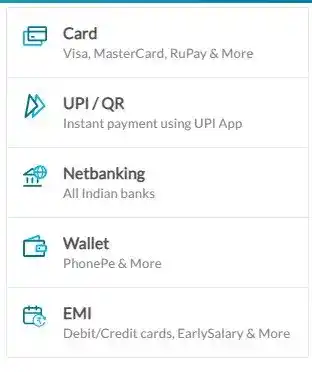
Udacity accepts major credit cards and PayPal. Apply your coupon code on the checkout page before completing payment — it cannot be applied retroactively.
Step 4: Onboarding.
After payment, there is a structured onboarding process before you access course content:
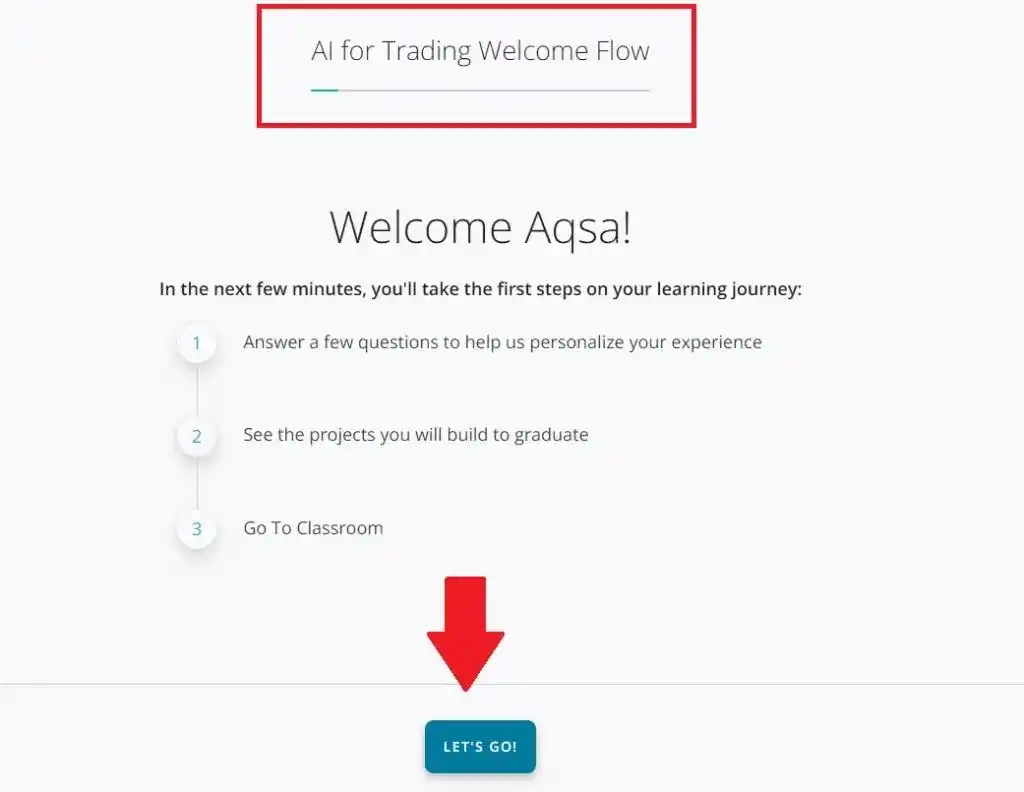
You complete a short questionnaire about your background and goals, review the full syllabus, and set up an individual study plan with specific weekly targets. This step takes 20-30 minutes and is worth doing properly, the study plan it creates gives you a week-by-week structure that makes the difference between finishing on schedule and drifting.
Step 5: Start learning.
Video lessons, quizzes, projects. The first project in most programs is designed to be completable within the first two weeks, giving you early success before the material becomes more challenging.
Step 6: Submit and revise projects.
Submit your project using the submission interface. A human mentor reviews it, typically within a few days, and returns it with detailed feedback. If it meets expectations, you move on. If it does not, you revise based on the feedback and resubmit. There is no limit on resubmissions, the goal is reaching professional standard, not a specific attempt count.
Step 7: Complete all projects and receive your certificate.
Once all projects and quizzes are completed with passing grades, your Nanodegree certificate is issued. It includes a shareable URL for LinkedIn, a PDF download, and a verification link.
Udacity Nanodegree Pros and Cons
What Udacity Does Better Than Most Platforms
Human project review. This is the single biggest differentiator. The quality of feedback from a practitioner who has read your specific code or analysis and given specific improvement guidance is substantially better for skill development than any automated grading system.
Industry-connected curriculum. Programs built with Google, AWS, NVIDIA, and Microsoft reflect current industry requirements. The Azure Generative AI Engineer Nanodegree built with Microsoft in 2024 and the Agentic AI Nanodegree added in 2025 are more current than most competitors’ equivalents.
Over 200 free courses. Before investing in a Nanodegree, you can explore Udacity’s free course catalog to understand the teaching style, verify the subject interests you, and build some prerequisite knowledge.
Career services included. Resume, cover letter, LinkedIn, and GitHub review are included in every Nanodegree at no additional cost.
Community and mentor discussion. Student forums and mentor support help you get unstuck on specific technical problems rather than spending hours searching for answers alone.
Accenture backing. Post-acquisition, Udacity’s enterprise credibility has increased. S&P Global used Udacity (through Accenture’s LearnVantage) to upskill 35,000 employees in AI. That scale of enterprise adoption adds weight to the Nanodegree credential.
→ Browse all Udacity Nanodegrees and check current pricing
What Udacity Does Less Well
Price. At $249-$399/month without a discount, Udacity is significantly more expensive than Coursera, Udemy, or free alternatives. The human review model is why, but the cost is real.
No mobile app (as of May 2026). All learning happens through the browser, which limits flexibility for learners who want to study on mobile.
No lifetime access on subscription model. Your access ends when your subscription does. Content you have not completed becomes unavailable after cancellation.
Certificate recognition varies by employer. Unlike Google or IBM certificates on Coursera, the Udacity brand is not universally recognized by all employers. Tech companies and startups tend to value the demonstrated project work. More traditional employers may weight the credential less.
Mentor response time varies. Some programs have fast, detailed mentor support. Others are slower and less specific. This is worth researching for the specific program you want before committing.
Udacity Nanodegree FAQ
Conclusion
I hope now you understood about Udacity Nanodegree. If you have any doubts or questions regarding Udacity Nanodegree, feel free to ask me in the comment section.
Udacity occupies a specific position in the online learning landscape in 2026 that no other platform quite matches. The human project review model, the industry-connected curriculum, and the Accenture backing combine to make it the strongest platform for learners who want structured, mentor-supported skill development in AI, data science, and cloud computing.
The price is real. It is a genuine premium over alternatives. The question to ask before enrolling is not whether Udacity is expensive (it is), but whether the human feedback and structured accountability are worth the premium for your specific situation and learning style.
If you have consistently started and not finished free courses, a financial commitment with mentor accountability changes the dynamic. If you learn well independently, the premium may not justify itself over free alternatives.
Check whether a discount or scholarship is available before paying full price. Udacity consistently offers 40-65% off, and that changes the calculation significantly.
→ Browse all Udacity Nanodegrees and check current pricing
All the Best!
Enjoy Learning!
You May Also Be Interested In
10 Best Online Courses for Data Science with R Programming
8 Best Free Online Data Analytics Courses You Must Know in 2026
Data Analyst Online Certification to Become a Successful Data Analyst
8 Best Books on Data Science with Python You Must Read in 2026
14 Best+Free Data Science with Python Courses Online- [Bestseller 2026]
10 Best Online Courses for Data Science with R Programming in 2026
8 Best Data Engineering Courses Online- Complete List of Resources
Thank YOU!
Explore More about Data Science, Visit Here
Though of the Day…
‘ It’s what you learn after you know it all that counts.’
– John Wooden

Written By Aqsa Zafar
Aqsa Zafar is a Ph.D. scholar in Machine Learning at Dayananda Sagar University, specializing in Natural Language Processing and Deep Learning. She has published research in AI applications for mental health and actively shares insights on data science, machine learning, and generative AI through MLTUT. With a strong background in computer science (B.Tech and M.Tech), Aqsa combines academic expertise with practical experience to help learners and professionals understand and apply AI in real-world scenarios.