
I get this question from students and working professionals at least once a week: “Are Coursera Certificates Worth It? or is it just something to put on LinkedIn?”
The honest answer is that it depends on which certificate, for which field, in which context, and that most articles answering this question either oversell Coursera or dismiss it entirely without making those distinctions. I’ve completed coursework on the platform myself, I work in a research environment where I interact with hiring outcomes regularly, and I’ve gone through the actual data on employer recognition to give you a grounded answer rather than marketing copy.
The short version: Yes, certain Coursera certificates are worth it, specifically the Professional Certificates from Google, IBM, Meta, and Microsoft. Generic individual courses from lesser-known instructors are a different story. The gap between the best and worst certificates on the platform is larger than most people realize.
Here’s everything you need to make an informed decision.
→ Try Coursera Plus free for 7 days: access 7,000+ courses No commitment during the trial. Cancel anytime.
Now, without further ado, let’s get started-
Are Coursera Certificates Worth It?
- Are Coursera Certificates Valid, Legitimate, and Do They Expire?
- Are Coursera certificates valid in India, and other countries?
- 1. Google Data Analytics Professional Certificate
- 2. IBM Data Science Professional Certificate
- 3. IBM AI Engineering Professional Certificate
- 4. Google Cybersecurity Professional Certificate
- 5. Machine Learning Specialization: DeepLearning.AI + Stanford
- 6. IBM Generative AI Engineering Professional Certificate
- 7. Google Project Management Professional Certificate
- Should you put a Coursera certificate on your resume?
What Coursera Actually Is (And How the Certificate System Works)
Coursera is an online learning platform that partners with over 350 universities, including Stanford, Yale, University of Michigan, and Johns Hopkins, and companies including Google, IBM, Meta, Microsoft, Amazon Web Services, and DeepLearning.AI. It now hosts more than 12,000 courses, Specializations, and certificates, with 191 million learners enrolled globally as of 2026, according to Coursera’s own 2025 learning trends report.
There are three distinct types of credentials on the platform, and understanding the difference matters because they carry very different weight with employers:
Individual Courses are standalone modules covering a specific topic, Python basics, SQL fundamentals, a single machine learning concept. Completing one earns you a certificate, but these are the weakest credentials on the platform. A one-week course certificate saying you “completed Introduction to Python” isn’t going to change how a recruiter sees your application.
Specializations are structured collections of 4–6 related courses that build toward a specific skill set. Andrew Ng’s Machine Learning Specialization from Stanford and DeepLearning.AI, for example, is a 3-month program that teaches genuine ML foundations. Specialization certificates carry more weight than individual course certificates because they represent a sustained commitment and build cumulative skill.
ndrew Ng’s Machine Learning Specialization from Stanford and DeepLearning.AI, for example, is a 3-month program that teaches genuine ML foundations. Specialization certificates carry more weight than individual course certificates because they represent a sustained commitment and build cumulative skill.
Professional Certificates are the flagship credential on Coursera, structured 4–6 month programs built specifically around a job role, designed in partnership with the companies that actively hire people into those roles. Google’s Data Analytics Professional Certificate, IBM’s Data Science Professional Certificate, and Meta’s Front-End Developer Certificate are examples. These are where Coursera’s strongest career outcomes come from, and they’re what most employers are actually referring to when they say they recognize Coursera credentials.
When someone asks “are Coursera certificates worth it,” they’re usually conflating all three types. The honest answer changes significantly depending on which one you mean.
Are Coursera Certificates Valid, Legitimate, and Do They Expire?
Before the “is it worth it” question, a lot of people are really asking something simpler first: is a Coursera certificate even valid, and does it expire? So let me answer those directly, because the answers are short and clear.
Are Coursera certificates valid? Yes, Coursera certificates are valid. When you complete a paid course, specialization, or Professional Certificate, you get a verifiable certificate with a unique credential ID and a URL that anyone can click to confirm it’s genuine. Employers and recruiters can verify it in one click, which is what makes it a real, checkable credential rather than just an image.
Do Coursera certificates expire? No, Coursera certificates do not expire. Once you earn one, it stays on your account and your LinkedIn permanently, with no renewal and no expiry date. The one caveat is that in fast-moving fields like AI and cybersecurity, the skills can date even though the certificate stays valid, IBM AI Engineering content, for example, was significantly updated in 2025 to add generative AI. The certificate from 2022 is still valid, but the curriculum has moved on.
Are Coursera certificates legitimate? Yes. Coursera is a real, well-established platform that partners with universities like Stanford and Yale and companies like Google and IBM. The certificates are legitimate professional credentials. What they are not is accreditation, Coursera is not an accredited academic institution, so a Coursera certificate is a professional credential, not a degree.
Are Coursera certificates accredited or recognized by employers? Coursera itself isn’t an accredited institution, but its certificates are widely recognized by employers, especially the Google, IBM, Meta, and Microsoft Professional Certificates. The recognition comes from the issuing company’s brand, not from academic accreditation. Recognition is strongest in tech, data, business, and IT roles, and weakest in regulated professions like medicine and law where formal accreditation is legally required.
How long are Coursera certificates valid, and what’s a credential ID? They’re valid indefinitely, there’s no validity period to track. Each certificate carries a credential ID, a unique code that appears on the certificate and links to a verification page. When you add a certificate to LinkedIn or a resume, include that credential ID or URL so anyone can confirm it’s real.
If you want to earn a verifiable certificate you can add to LinkedIn, you can start a Coursera Professional Certificate here.
What the Actual Data Says About Employer Recognition
Here’s the research worth knowing, with direct links to every source so you can read the originals rather than taking my word for it.
Coursera’s 2025 Learner Outcomes Report was conducted with The Harris Poll, surveying 52,000+ learners across 179 countries. It found that 91% of career-focused learners achieved a positive outcome after completing a program, new jobs, promotions, or salary increases. 46% specifically reported a salary increase. For learners who completed an Entry-Level Professional Certificate specifically, 51% reported a salary increase. You can view the full report data on Coursera’s outcomes page.
I’ll be direct about these numbers: they come from a Coursera-funded study, which means they should be read with appropriate skepticism. The platform has an obvious incentive to report positive outcomes. But the direction of the findings is supported by independent data.
The NACE (National Association of Colleges and Employers) is an independent industry body that surveys employers annually about hiring criteria and credential recognition. Their 2024 employer survey data found that 87.4% of US employers accept online professional certificates as valid screening credentials for entry-level roles. This is not a Coursera statistic. NACE’s surveys are employer-facing and are widely cited in university career services and HR research. The NACE job market research page has current hiring data, though full survey access requires membership.
The Coursera 2025 Micro-Credentials Impact Report (surveying 2,000+ students and employers across six regions) found that 96% of employers say micro-credentials strengthen a candidate’s job application, and 90% are willing to offer higher starting salaries to candidates who hold recognized credentials. GenAI enrollments on the platform also surged 195% year-over-year according to the 2025 Global Skills Report, making it the fastest-growing skill category.
The Google Career Certificate Hiring Consortium is the most concrete evidence of real employer commitment. Over 150 companies, including Deloitte, Accenture, T-Mobile, SAP, and Walmart, have formally committed to considering Google Career Certificate graduates for entry-level roles. Google reports that 75% of graduates who sought employment after completing their program achieved a positive career outcome within six months.
Are Coursera certificates valid in India, and other countries?
Coursera certificates are valid and recognized internationally, the credential and its verification work the same everywhere. In practice, recognition depends more on the issuer than the country. A Google or IBM Professional Certificate carries weight with recruiters in India, the UK, Canada, the Philippines, and elsewhere because those are global brands. In markets like India specifically, where employers increasingly accept skills-based credentials for tech and data roles, a recognized Professional Certificate paired with real project work is a genuine advantage for entry-level applications. What doesn’t travel well is a generic individual-course certificate, that carries little weight in any country.
You can browse all Coursera Professional Certificates here to see the full current catalog before deciding.
The Critical Distinction: Not All Coursera Certificates Are Equal
This is what most guides miss, and it’s the most important thing to understand before investing time and money.
Certificates that carry real weight in 2026:
The Google Professional Certificates: Data Analytics, Cybersecurity, IT Support, Project Management, UX Design, AI Essentials: carry genuine weight with employers because of the Google brand, the 150+ company Hiring Consortium, and the fact that these programs are built around actual Google hiring standards. The Google Data Analytics Professional Certificate has over 2.1 million enrolled learners and a 4.8/5 rating. It targets data analyst roles with median US salaries around $93,000. When a recruiter sees “Google Data Analytics Professional Certificate” on a resume, they recognize Google first. The credential gets through the filter because of the issuer’s brand recognition, not just the Coursera platform name.
The IBM Professional Certificates: IBM Data Science, IBM AI Engineering, IBM Generative AI Engineering, IBM Machine Learning: are the strongest option for people targeting technical AI and data science roles. IBM’s certificates go deeper technically than Google’s, with hands-on labs using real datasets and capstone projects that produce actual portfolio artifacts. The IBM Data Science Professional Certificate is consistently rated as the most respected in technical interviews for analytics and ML roles. IBM refreshed its Generative AI content in early 2025 to include production-grade LLM techniques, making it one of the most current programs on the platform for that skill area. If you’re deciding between the data science and data analyst tracks within IBM’s catalog, our IBM Data Science vs IBM Data Analyst comparison covers the difference in detail.
Meta (Front-End Developer, Data Analyst) and Microsoft (Azure Data Scientist, Power BI Data Analyst) certificates are strong within their specific niches: web development and Microsoft-stack business intelligence, respectively. They’re not as broadly recognized as Google and IBM certificates, but they’re the right choice if those specific roles or tech stacks match your target.
Certificates that carry less weight: Generic individual courses, specializations from lesser-known instructors, and certificates covering very broad topics without a clear employer connection are much harder to leverage. A certificate saying “Introduction to Machine Learning” from an unrecognized provider is essentially decoration on a resume. The issuing organization matters enormously. When employers see “Google” or “IBM” as the issuer on a Coursera certificate, they recognize the brand independently of the platform: and that brand recognition is doing most of the hiring work.
Are Coursera Certificates Worth It for Data Science and AI Specifically?
Since most of the audience on this site is working toward data science, machine learning, or AI careers, I want to be specifically useful here rather than giving a generic answer.
For data science roles: The IBM Data Science Professional Certificate (9 courses, ~$49/month) and the Google Data Analytics Professional Certificate are both legitimate starting points, but they target different levels. IBM goes significantly deeper technically: Python, SQL, machine learning, and a capstone project with real datasets. Google is more accessible for people with less technical background and has broader employer recognition through the Hiring Consortium. If you’re targeting a data scientist role rather than a data analyst role, IBM is the stronger path.
For machine learning specifically: The Machine Learning Specialization from Andrew Ng and DeepLearning.AI (Stanford-backed, 3 months) remains the most respected ML credential on Coursera for technical roles. This is one of the cases where a Specialization, not a Professional Certificate, carries more weight — because the Stanford and DeepLearning.AI brands are independently recognized in the ML research and engineering community.
For AI engineering and generative AI: The IBM Generative AI Engineering Professional Certificate is specifically worth mentioning for 2026 because it covers retrieval-augmented generation (RAG), LLM deployment, and agentic AI systems: the skills that 2026 job postings for AI engineer roles are specifically asking for. IBM updated this content in 2025 to reflect production-grade techniques, not just theoretical concepts. Our best AI certification courses guide covers how this compares to other platforms and vendor certifications.
One honest caveat that applies across all of these: in 2026, hiring managers are moving toward what they’re calling “competency validation.” The certificate gets your resume past the ATS (applicant tracking system).
The portfolio work you produce during and after the program is what closes the deal in interviews. One recruiter perspective that I’ve seen referenced repeatedly: “I don’t care that you have the Google Data Analytics certificate. I care that you used the skills to analyze a dataset relevant to my industry, not the same generic bike-share data that thousands of other applicants submit.” Building one real, original project on top of the course capstone makes the difference between getting a second-round interview and not.
Ready to enroll? Direct links to the programs covered above:
- IBM Data Science Professional Certificate — Enroll on Coursera
- Google Data Analytics Professional Certificate — Enroll on Coursera
- Machine Learning Specialization by Andrew Ng (Stanford / DeepLearning.AI) — Enroll on Coursera
- IBM Generative AI Engineering Professional Certificate — Enroll on Coursera
Coursera vs. a University Degree: The Honest Comparison
People frame this as either/or, but the reality is more nuanced than that framing suggests.
Where Coursera certificates work as an alternative to a degree: In tech roles, software engineering, data analysis, IT support, cybersecurity, employers have been shifting toward skills-based hiring for years. NACE’s Job Outlook 2026 survey found that 70% of employers are now using skill-based hiring, up from 65% the previous year. In these fields, a Google or IBM Professional Certificate paired with real project work is regularly sufficient to get an interview for entry-level roles.
For career changers specifically, Coursera Professional Certificates have a genuine track record. The structured curriculum, the project work, and the recognizable brand on the certificate provide a credible bridge from one field to another in 3–6 months. According to Coursera’s 2025 outcomes data, 37% of unemployed learners found employment after completing a program. 79% of learners who reported performance improvements at work did so within three months of completing their program.
Where university degrees still matter more: Regulated professions, medicine, law, engineering with licensure requirements, government roles with formal education requirements, still need formal accreditation that Coursera cannot provide. Coursera itself is not an accredited institution. Some Google Career Certificates carry ACE (American Council on Education) credit recommendations worth up to 15 college credits at participating institutions, which is meaningful, but these are not academic degrees.
For research-oriented positions or PhD program applications, academic credentials and publications carry far more weight than Professional Certificates. For senior roles in traditional industries like banking, manufacturing, or government, formal degree requirements remain more entrenched.
The cost comparison: A traditional 4-year CS degree: $40,000–$200,000+. A bootcamp: $10,000–$20,000 for 3–6 months. Coursera Plus: $399/year for unlimited access to most Professional Certificates. Two certificates in a year via Coursera Plus saves money over paying per program and covers the credential side of career preparation. The skill outcomes aren’t equivalent to a four-year degree, but they’re not supposed to be. The question is whether the outcome matches your goal, and for entry-level tech transitions, they frequently do.
How Much Does a Coursera Certificate Cost? (Full Breakdown)
Coursera’s pricing confuses people because there are multiple access paths. Here’s the clear version:
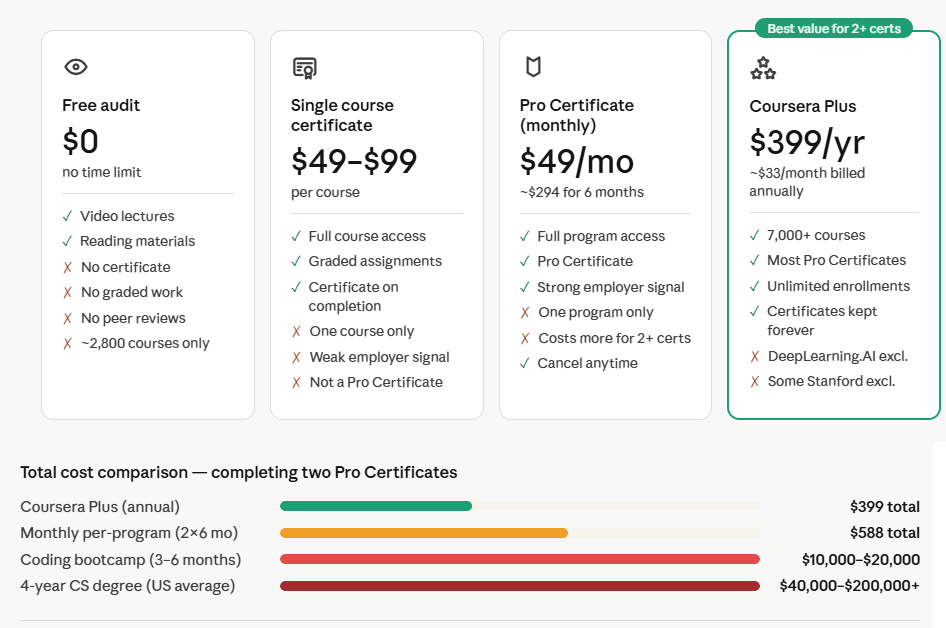
Free audit: Available on roughly 2,800 courses. Full access to video lectures and readings, but no certificate, no graded assignments, no peer-reviewed work. Genuinely useful for learning without credentialing, many excellent practitioners use this exclusively.
Individual course certificates: Typically $49–$99 per course. Reasonable for a 4-week course covering a practical skill. Expensive relative to value for a short introductory module.
Professional Certificate subscriptions: Most Professional Certificates cost $49/month on a monthly subscription. A 6-month program = approximately $294 total. Completing it faster reduces cost.
Coursera Plus: $399/year (or $59/month billed monthly). Gives unlimited access to 7,000+ courses and most Professional Certificates. The math works in your favor if you complete two or more certificates in a year, the annual subscription saves roughly $200 versus paying per program.
What’s NOT included in Coursera Plus: This matters and most articles don’t mention it. DeepLearning.AI’s most advanced Specializations (including Andrew Ng’s Deep Learning Specialization), some Stanford MasterTrack certificates, and certain premium university programs require separate payment even with Coursera Plus active. If those specific programs are your goal, calculate the monthly subscription cost for that program directly rather than assuming Plus covers it.
Financial aid: Coursera’s financial aid program can cover up to 100% of course costs for qualifying learners. The application is a short form on the course page asking about your financial situation and learning goals. Response time is approximately 15 days. This is underused, many people who qualify simply don’t know it exists or assume they won’t be approved.
→ Get Coursera Plus for $399/year, unlimited access to 7,000+ courses and Professional Certificates
Coursera Certificates Worth It in 2026: The Ranked List
Based on employer recognition data, career outcomes, technical depth, and completion rates, these are the programs with the strongest track records. Direct enrollment links are included for each.
1. Google Data Analytics Professional Certificate
Best for: Career changers targeting data analyst roles
Duration: ~6 months at 10 hrs/week
Cost: ~$234 via Plus or $39/month
Employer recognition: Highest on the platform via 150+ company Hiring Consortium
Median salary for target role: ~$93,000 (US)
The most enrolled certificate on Coursera (2.1M+ learners, 4.8/5 rating). Covers spreadsheets, SQL, R programming, Tableau, and real-world case studies. The 150+ company Hiring Consortium is the single strongest employer connection on the platform, it’s not just recognition, it’s active recruiting pipeline access.
→ Enroll in Google Data Analytics Professional Certificate
2. IBM Data Science Professional Certificate
Best for: People targeting data scientist or ML engineer roles
Duration: ~8 months at 10 hrs/week
Cost: ~$392 via Plus or $49/month
Employer recognition: Strongest for technical interviews in analytics and ML
Median salary for target role: $100,000–$120,000 (US)
12 courses covering Python, SQL, data visualization, machine learning, and a capstone project. Recently updated with a Generative AI module. The most technically rigorous data science certificate available on Coursera. Before deciding between this and Google’s analytics certificate, see our full IBM vs Google certificate comparison for a side-by-side breakdown.
→ Enroll in IBM Data Science Professional Certificate
3. IBM AI Engineering Professional Certificate
Best for: People targeting AI developer or ML engineering roles
Duration: ~4–6 months
Cost: ~$196–$294 via Plus
Employer recognition: Strong in technical AI interviews
Entry-level salary range: $85,000–$120,000 (US)
Covers Python, machine learning frameworks, deep learning, neural networks, computer vision, NLP, and deploying AI applications as real portfolio work. IBM refreshed the generative AI content in 2025. Entry-level AI developers with this background typically start at $85,000–$120,000 according to Coursera’s career outcomes data.
→ Enroll in IBM AI Engineering Professional Certificate
4. Google Cybersecurity Professional Certificate
Best for: Career changers entering cybersecurity
Duration: ~6 months at 7 hrs/week
Cost: ~$294 via Plus
Why it works: Global cybersecurity talent shortage means employers actively seek alternative credentials
Entry-level salary range: $55,000–$85,000 (US)
Cybersecurity is one of the few fields where alternative credentials are actively sought precisely because the talent shortage is so severe. The Coursera 2025 Global Skills Report found cybersecurity enrollments rose 106% in Latin America and 20% in Europe year-over-year, while nearly 5 million additional cybersecurity professionals are still needed worldwide. That supply gap is what makes the Google Cybersecurity certificate particularly effective, demand exceeds supply enough that employers are actively lowering credential requirements to fill roles.
→ Enroll in Google Cybersecurity Professional Certificate
5. Machine Learning Specialization: DeepLearning.AI + Stanford
Best for: People specifically targeting data science and ML engineering
Duration: ~3 months at 10 hrs/week
Cost: Separate from Coursera Plus
Employer recognition: Highest technical credibility for ML roles specifically
Note: Not included in Coursera Plus, subscribe to the specialization directly
Andrew Ng built this specialization with Stanford backing, and it remains the most academically credible ML credential available on any online platform. Covers supervised learning, unsupervised learning, and deep learning fundamentals. The Stanford and DeepLearning.AI brands carry independent recognition in technical hiring, separate from the Coursera platform itself.
→ Enroll in the Machine Learning Specialization
6. IBM Generative AI Engineering Professional Certificate
Best for: Developers and engineers wanting to build AI applications
Duration: ~5–7 months
Cost: ~$245–$343 via Plus
Why it’s important in 2026: Covers RAG, LLM deployment, agentic AI, skills in active demand
Specialist salary range: $140,000–$220,000+ for RAG and agentic AI roles
The most current program on Coursera for the 2026 AI job market. IBM updated this in 2025 to cover retrieval-augmented generation (RAG) systems, LLM deployment, and production-grade AI application development. According to data cited by InfoWorld, AI and ML hiring grew 88% year-over-year in 2025, with major consulting firms including Deloitte, Accenture, PwC, and KPMG among the top 25 AI hirers in the US.
→ Enroll in IBM Generative AI Engineering Professional Certificate
7. Google Project Management Professional Certificate
Best for: Professionals moving into project management roles
Duration: ~6 months at 10 hrs/week
Cost: ~$234 via Plus
Market size: 87.7 million project management roles projected needed by 2027
Median salary: $70,000–$100,000 (US)
Project management is one of the most transferable skill sets across industries, and the Google-branded certificate opens doors in the same way as the Data Analytics certificate, through the same Hiring Consortium, with the same brand recognition advantage.
→ Enroll in Google Project Management Professional Certificate
Still deciding? Browse the full Coursera Professional Certificate catalog here: filter by field, duration, and skill level to find what matches your goal.
Does a Coursera Certificate Actually Help You Get a Job?
The honest answer with evidence: it helps you get through the first filter. The portfolio work closes the deal.
In 2026, the shift among employers is toward what recruiters are calling “competency validation.” Getting past an ATS with a recognized certificate name is only the first hurdle. In the interview, employers want to see that you built something real with the skills, not just completed the videos and passed the quizzes. One hiring manager perspective referenced in multiple recruiter forums: “I don’t care that you have the Google Data Analytics certificate. I care that you used the skills on data from my industry , not the same generic bike-share dataset that thousands of other applicants submit.”
What this means practically: the certificate gets your resume noticed. The original project you build on top of the capstone, using data relevant to your target industry, published on GitHub, written up somewhere people can find it, is what gets you through the interview. Plan for 4–6 weeks of independent project work after completing the program before you start applying. That sequence consistently outperforms completing the certificate and immediately sending applications.
Coursera vs. Udemy: Which Platform’s Certificates Carry More Weight?
This comparison comes up constantly, and the honest answer is that they serve different purposes and shouldn’t be treated as competitors for the same use case.
Coursera is better when you need a recognized employer-facing credential. Its Professional Certificates come from Google, IBM, Meta, and accredited universities, and those brand names carry genuine hiring weight. The structured curriculum and graded projects also produce demonstrable outcomes that you can reference in interviews.
Udemy is better for fast, affordable, practical skill-building at low cost. A $10–$15 Udemy course during a sale covers a specific technical skill (Pandas, PyTorch, SQL queries) efficiently. Udemy certificates carry less employer recognition, but the skills transfer just as well. Our Coursera vs Udemy comparison for data science covers the full trade-off if you’re deciding where to focus.
Many learners use both strategically: Coursera for the Professional Certificate that goes on LinkedIn and the resume, Udemy for building the specific technical skills they need to complete the capstone and subsequent projects faster. That combination often produces better results than either platform alone.
Should you put a Coursera certificate on your resume?
Yes, if it’s one of the recognized Professional Certificates and you list it correctly. Put it under a “Certifications” section with the full title and the issuing company named as Google, IBM, or Meta, not “Coursera.” Recruiters recognize the company brand first, so leading with it is what gets the credential noticed. Skip listing short, generic individual-course certificates on your resume, a long list of one-week course completions can read as filler rather than strength. One strong Professional Certificate plus a real project beats ten small course certificates every time.
How to Get a Coursera Certificate for Free (Legitimately)
Audit the course: Approximately 2,800 courses on Coursera can be audited for free. Full video lectures and readings, but no certificate and no graded work. Genuinely useful for learning the content before deciding whether to pay for the credential.
Apply for financial aid: Coursera’s financial aid program can cover up to 100% of course costs for eligible learners. Apply directly on the course page, there’s a short form asking about your financial situation and learning goals. Expect a response within about 15 days. This is widely available and underused. Many people who would qualify don’t apply because they assume the process is complicated or that they won’t be approved.
7-day free trial: Coursera Plus offers a 7-day free trial during which graded assignments are accessible. If you move quickly through a short program’s early modules during the trial period, this is a legitimate option for getting a head start before deciding to subscribe.
→ Start your 7-day free Coursera Plus trial: no charge until the trial ends
How to Add a Coursera Certificate to LinkedIn (Step by Step)
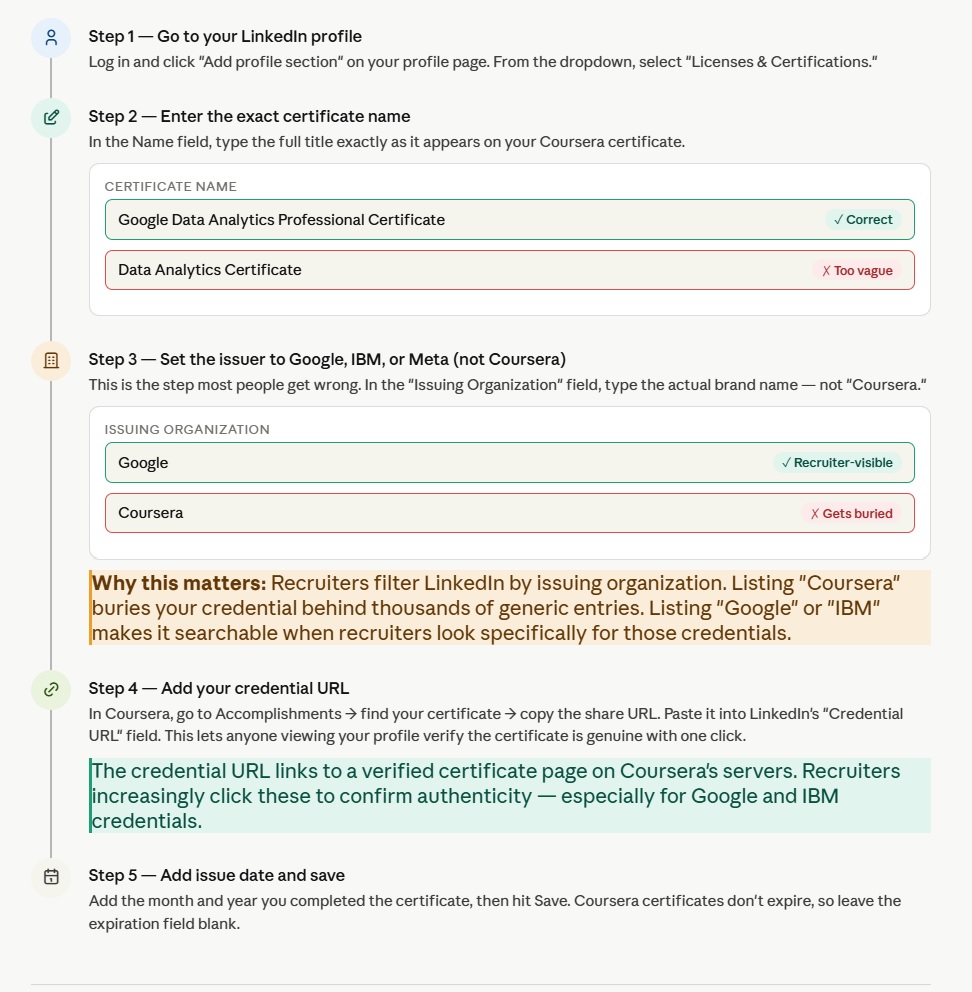
Adding your certificate correctly matters more than most people realize, specifically, making the issuing organization show as Google, IBM, or Meta rather than just “Coursera.” Recruiters filter by issuer when searching LinkedIn, and listing the actual company brand dramatically increases visibility.
- Log into LinkedIn and navigate to your profile.
- Click “Add profile section” and select “Licenses & Certifications.”
- In the Name field, enter the full, exact certificate title as it appears on your Coursera certificate, for example, “Google Data Analytics Professional Certificate.”
- In Issuing Organization, type “Google”: not “Coursera.” This is the step most people get wrong. Listing Coursera as the issuer buries your credential. Listing Google, IBM, or Meta makes it searchable when recruiters filter for those specific credentials.
- Add the credential URL from your Coursera Accomplishments page. This allows anyone viewing your profile to verify the certificate is genuine with one click.
- Add the issue date and save.
Frequently Asked Questions
The bottom line: A Coursera certificate is worth it when three things line up, it’s a Professional Certificate from a recognized issuer (Google, IBM, Meta, Microsoft), it matches the role you’re actually targeting, and you build a real project on top of it. Miss any of those and the value drops fast. It’s valid, it doesn’t expire, and it’s legitimate, but it’s a professional credential, not a degree, and it opens the door rather than doing the whole job. Check ten real job postings for your target role first: if the certificates you’re considering show up there, you have your answer.
If you’ve decided it’s worth it, the strongest starting points are the Google Data Analytics and IBM Data Science Professional Certificates, or you can try Coursera Plus free for 7 days to explore before committing.
Conclusion
The right Coursera certificates, specifically Professional Certificates from Google, IBM, Meta, and Microsoft, are worth it in 2026. The employer data across multiple independent sources supports this. The cost is a fraction of alternative paths. The skills are transferable and current.
The certificates that aren’t worth it: generic individual courses from unrecognized instructors, anything you complete without doing the project work seriously, and programs in fields where formal accreditation is legally required.
Before enrolling in anything, pull 10 real job postings for the role you’re targeting. See which certifications they specifically mention or prefer. If Google Data Analytics or IBM Data Science appears in those postings, you have your answer. If nothing on Coursera appears for your target role, that’s equally useful information.
The certificate is the starting point. The skills and portfolio you build with it are the actual career asset.
→ Browse all Coursera Professional Certificates and find your program
→ Start with the 7-day free Coursera Plus trial: explore before you commit
So, yes, they can be worth it if they match your goals and you use them smartly. I hope now you understand Are Coursera Certificates Worth It?
Happy Learning!
You May Also Be Interested In
Best Resources to Learn Computer Vision (YouTube, Tutorials, Courses, Books, etc.)- 2026
Best Certification Courses for Artificial Intelligence- Beginner to Advanced
Best Natural Language Processing Courses Online to Become an Expert
Best Artificial Intelligence Courses for Healthcare You Should Know in 2026
What is Natural Language Processing? A Complete and Easy Guide
Best Books for Natural Language Processing You Should Read
Augmented Reality Vs Virtual Reality, Differences You Need To Know!
What are Artificial Intelligence Examples? Real-World Examples
Thank YOU!
Explore more about Artificial Intelligence.
Thought of the Day…
‘ It’s what you learn after you know it all that counts.’
– John Wooden

Written By Aqsa Zafar
Aqsa Zafar is a Ph.D. scholar in Machine Learning at Dayananda Sagar University, specializing in Natural Language Processing and Deep Learning. She has published research in AI applications for mental health and actively shares insights on data science, machine learning, and generative AI through MLTUT. With a strong background in computer science (B.Tech and M.Tech), Aqsa combines academic expertise with practical experience to help learners and professionals understand and apply AI in real-world scenarios.