
So most people who want to learn AI right now don’t want to code. They don’t want to sit through math or change careers either. They just want to understand what AI actually does and use it well at work. And that’s exactly who Google built AI Essentials for. That’s why I went through the whole program myself before writing this Google AI Essentials Course Review.
Let me give you the short version first, so you don’t have to scroll. Is Google AI Essentials worth it? Yes, if you’re a beginner or a non-technical professional who wants to use AI tools confidently at work. It’s a self-paced Google program on Coursera. It costs around $49 per month, most people finish in under 10 hours, and it needs no coding. You get a certificate from Google at the end. But if you already use ChatGPT or Gemini every day, or you want to build AI models and write Python, it’s going to feel too basic. In that case, skip it.
So that’s my verdict. Now let me show you how I got there. I’ll go course by course, tell you what it really costs, where it falls short, how it compares to the other beginner AI certificates, and who genuinely shouldn’t buy it.
Now, without further ado, let’s get started with Google AI Essentials Course Review:
Google AI Essentials Course Review
- Quick verdict at a glance
- Is Google AI Essentials a course, a specialization, or a certificate?
- Is the Google AI Essentials course worth it?
- Why I went through it
- What you actually learn (all 5 courses)
- How much does Google AI Essentials cost?
- How long does it take?
- The honest pros and cons
- Is the Google AI Essentials certificate worth it?
- Google AI Essentials vs the other beginner AI certificates
- Final Thoughts: is it worth it in 2026?
- FAQ
Quick verdict at a glance
| My rating | 4 / 5 for beginners 2 / 5 if you already use AI daily |
| Format | Specialization, 5 short courses, one certificate |
| Rating on Coursera | 4.8 ★ from 22,000+ reviews 1.8M+ enrolled |
| Best for | Non-technical professionals who want to use AI at work |
| Cost | ~$49/month on Coursera (most finish in one month) |
| Time | Google lists 4 hours; the 5 courses total ~8 hours; realistically 10–12 if you do every activity |
| Coding | None |
| You get | A shareable certificate from Google for LinkedIn |
| Skip it if | You already use ChatGPT/Gemini daily or want to build models |
If that sounds like you, the easiest way to decide is to try it yourself. You can start Google AI Essentials with Coursera’s 7-day free trial and preview the lessons before paying anything.
Is Google AI Essentials a course, a specialization, or a certificate?
People search for all three, and honestly the confusion is fair. So let me clear it up in one place. Google AI Essentials is a specialization. That means it’s a series of five short courses that together take under ten hours and earn you a single certificate from Google. Plenty of people call it a “course,” which is close enough in everyday talk. But if you go looking on Coursera, you’ll see it listed as a specialization made up of five courses. So whichever word you searched, it’s the same program. And yes, the certificate at the end is real, and you can share it on LinkedIn.
It’s created by Google Career Certificates and hosted on Coursera. It teaches you to use generative AI in your work, not build it. There’s no coding, and no prior AI knowledge assumed. The main tool you’ll work with is Google Gemini, plus Google Sheets and Workspace.
Is the Google AI Essentials course worth it?
So is it worth it? It depends on what you actually want. If your goal is practical AI literacy, yes, it’s worth it. If your goal is technical depth, no, it’s a waste of money. That’s the honest answer. And it’s a lot more useful than the “yes, absolutely, enrol now” you’ll read on pages that are only trying to sell you something.
So think about your work. Are you a marketer, teacher, manager, writer, analyst, or student? Basically anyone whose job doesn’t involve building software? Then this gives you a real, structured foundation for very little money and time. The responsible-AI course alone goes deeper than most free tutorials bother to. And that’s the part that actually matters once you’re using these tools on work you’re responsible for.
But if you already open ChatGPT or Gemini every morning and can write a decent prompt, you already know most of what’s inside. Paying to be told things you do daily makes no sense. I’d rather you keep the money.
Why I went through it
I didn’t enrol to become an AI engineer. I went through it for a different reason. Readers keep emailing me asking where a non-coder should start with AI. And I wanted to know whether this was a program I could actually stand behind. So I worked through it the way a beginner would. I paid attention to where it genuinely helped, and where it dragged. The course-by-course breakdown below comes straight from those notes.
What you actually learn (all 5 courses)
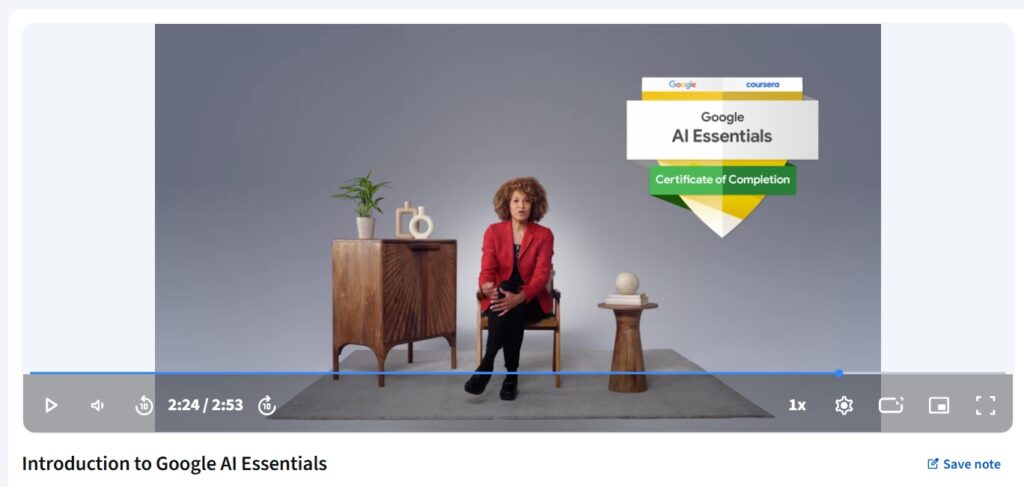
Most reviews rush this part, or get the structure wrong. So let me walk you through what’s really inside, course by course, with the real running times.
Course 1: Introduction to AI (1 hour). This covers what AI is in plain language. How it’s trained to learn from data, what it can and can’t do, and why human oversight matters. If you already grasp the basics, you’ll move through this quickly. And that’s fine.
Course 2: Maximize Productivity With AI Tools (2 hours). This is about where generative AI fits into real work. Brainstorming, organizing, drafting, summarizing. It also shows you how to judge whether AI is even the right tool for a task in the first place. The examples map cleanly onto Google Workspace and everyday office work.
Course 3: Discover the Art of Prompting (2 hours). For my money, this is the most valuable course in the whole specialization. It’s the reason I’d recommend the program even to people who are AI-curious rather than total beginners. You learn to write clear, specific prompts. You learn techniques like few-shot prompting. And you learn to refine an output instead of accepting the first thing the model hands you. Wondering whether this generative AI course is worth it just for the prompting skills? This is the course that justifies it.
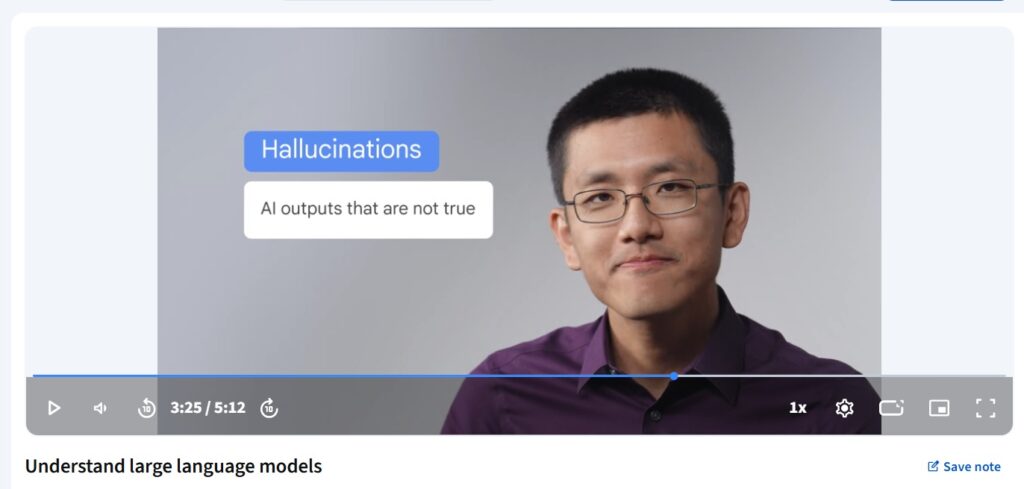
Course 4: Use AI Responsibly (1 hour). This one covers how AI can cause harm. Where bias and privacy risks come from, and practical guidelines for using AI responsibly at work. You come away with a checklist you’ll actually use. I wanted more real-world cases here, but the awareness it builds is genuinely worth having.
Course 5: Stay Ahead of the AI Curve (2 hours). This is about how to keep learning as the tools change. How organizations are folding AI into existing work, and how to add AI into your own routine gradually. It works as a closing overview. It points you toward what’s next, instead of treating the certificate as the finish line.
So that’s all five courses. If this sounds like the kind of practical, no-code start you’re after, you can look through the full syllabus on Coursera and start the free trial to see the first course for yourself.
How much does Google AI Essentials cost?
So the program runs on Coursera’s subscription at around $49 per month. But here’s the thing. Most people finish in under ten hours. So if you set aside a focused week or two, you can finish all five courses inside a single billing cycle and pay only once. That makes the real cost closer to one month than anything bigger. It’s genuinely worth planning your schedule so you finish before the month renews. You can check the current price and start with a 7-day free trial before you’re charged anything.
And $49 is cheap when you compare it. A single AWS or Azure certification exam costs $150 to $300 just to sit. A university AI module runs into the thousands. So for a recognized, Google-built credential, this sits right at the cheap end.
And there are three ways to pay less, or nothing at all. First, the seven-day free trial gives you full access to preview everything. Second, Coursera’s financial aid, which you apply for on the course page, gets approved for a lot of applicants worldwide and can bring your cost to zero. Third, audit mode lets you watch the video lessons for free. You just don’t get the graded activities or the certificate that way.
How long does it take?
So Google’s header says four hours. But the five courses actually add up to about eight hours of material. And if you watch everything, do the activities, and read the extra material, it’s closer to ten to twelve hours. Reviewers who say “five hours” and reviewers who say “fifteen” are both guessing. The honest number sits in between. It’s fully self-paced, so at an hour a day you’ll be done in a couple of weeks.
The honest pros and cons
What works well. The content is genuinely easy to follow, even with no AI background. The examples are practical and tied to real work, not toy scenarios. The responsible-use course goes deeper than most beginner material bothers to. And the self-paced format makes it realistic to finish alongside a full-time job.
Where it falls short. If you already understand AI basics, parts of it will feel repetitive. The real-world case studies stay pretty high level. And it won’t prepare you for technical or engineering AI roles. The course never claims it will. But people enrol expecting it anyway, so it’s worth saying plainly.
Is the Google AI Essentials certificate worth it?
So on its own, no certificate gets you hired. Any review promising otherwise is selling you something. What this one does is signal to an employer that you’ve taken real, structured steps to understand and use AI. And in 2026, that’s quietly shifting from a nice-to-have to an expectation in a lot of non-technical roles. So think of it as a credibility marker, not a job guarantee.
Where it pays off is on your resume and LinkedIn, as proof you’re adapting. Especially when you pair it with actually using AI in your current work. Where it won’t move the needle is technical AI jobs. Those need real projects and coding. So if a data or ML role is your actual goal, treat this as a warm-up, and plan a more technical path afterward.
Google AI Essentials vs the other beginner AI certificates
This is the comparison most reviews skip. But it’s what you actually need to make a decision. So here’s how the main non-technical options stack up.
| Program | Best for | Coding? | Rough cost | Notes |
|---|---|---|---|---|
| Google AI Essentials | Non-technical professionals wanting practical AI literacy | No | ~$49/mo (≈1 month) | Strongest brand, most beginner-friendly, Gemini-based |
| Microsoft AI Fundamentals (AI-900) | People in or moving toward the Azure ecosystem | No | ~$99 exam | Cloud-focused, exam-based |
| IBM AI Foundations | Learners who want to move toward hands-on development | Some | ~$49/mo on Coursera | Deeper and more technical |
| Generative AI specializations (deeplearning.ai etc.) | Learners ready for light theory and technical depth | Some | ~$49/mo | Steeper, more conceptual |
So which one? If you want the gentlest, most recognized on-ramp and you don’t code, Google AI Essentials is the pick. You can start it here. If you’re heading toward the Microsoft stack, AI-900 fits better. And if you already suspect you’ll want to build things one day, the IBM path goes deeper.
Now, it’s time to wrap this Google AI Essentials Course Review.
Final Thoughts: is it worth it in 2026?
So for beginners and non-technical professionals, yes. It does exactly what it promises within a narrow scope. It makes you comfortable understanding and using AI at work. It’s cheap, it’s fast, and it carries Google’s name. The prompting course alone is worth the price for most people. And the responsible-AI course is better than a lot of what’s out there. With a 4.8 rating from more than 22,000 learners, I’m clearly not the only one who thinks so.
But if you already use AI daily, or you want technical, model-building skills, it’s too basic. In that case I’d tell you to skip it and put the money toward something deeper.
Either way, treat the certificate as step one, not the destination. The people who get real value out of it are the ones who start using what they learned in their actual work the same week. If that’s you, you can enrol and start the free trial on Coursera here.
I hope this Google AI Essentials Course Review has helped you decide if it’s right for you. If you have any questions or have already taken the course and want to share your thoughts, feel free to connect with me. I’d love to hear from you!
FAQ
You May Also Be Interested In
Best Resources to Learn Computer Vision (YouTube, Tutorials, Courses, Books, etc.)- 2026
Best Certification Courses for Artificial Intelligence- Beginner to Advanced
Best Natural Language Processing Courses Online to Become an Expert
Best Artificial Intelligence Courses for Healthcare You Should Know in 2026
What is Natural Language Processing? A Complete and Easy Guide
Best Books for Natural Language Processing You Should Read
Augmented Reality Vs Virtual Reality, Differences You Need To Know!
What are Artificial Intelligence Examples? Real-World Examples
Thank YOU!
Explore more about Artificial Intelligence.
Thought of the Day…
‘ It’s what you learn after you know it all that counts.’
– John Wooden

Written By Aqsa Zafar
Aqsa Zafar is a Ph.D. scholar in Machine Learning at Dayananda Sagar University, specializing in Natural Language Processing and Deep Learning. She has published research in AI applications for mental health and actively shares insights on data science, machine learning, and generative AI through MLTUT. With a strong background in computer science (B.Tech and M.Tech), Aqsa combines academic expertise with practical experience to help learners and professionals understand and apply AI in real-world scenarios.