
Are you looking for the Best Agentic AI Courses Online in 2027? And you’ve noticed every blog is suddenly listing the “best agentic AI courses” without telling you which one actually fits where you are. Let me fix that.
I’m Aqsa Zafar. I’m a PhD scholar in Machine Learning, I run MLTUT, and I build AI agents myself. I completed Udacity’s Agentic AI Nanodegree, and on my YouTube channel I build agents with LangGraph, RAG, and MCP, run them locally with Ollama, and show the messy parts. So this isn’t a list I scraped from course catalogs. It’s the courses and resources I’d actually point you to, grouped by where you are and what you want to build.
In this guide I’ll explain what agentic AI really is, how it works, how it differs from the ChatGPT-style AI you already know, the skills you need first, and then the best agentic AI courses online for every level, from free beginner intros to the deep developer programs that get you hired. Find your level, read that part, skip the rest.
If you want my full course-by-course ranking of AI agent courses specifically, I keep that in a separate guide: Best AI Agent Courses. This page is the bigger-picture agentic AI learning hub.
Now, let’s get started-
Best Agentic AI Courses Online
- 1. Agentic AI, DeepLearning.AI (Andrew Ng), Free to Audit
- 2. DeepLearning.AI Short Courses (crewAI and LangGraph), Free
- 3. Agentic AI Nanodegree, Udacity (My Pick for Projects)
- 4. Agentic AI and AI Agents for Leaders, Coursera (Vanderbilt)
- 5. Building AI Agents and Agentic Workflows, Coursera (Specialization)
- 6. The Complete Agentic AI Engineering Course, Udemy (Ed Donner)
- 7. RAG and Agentic AI Professional Certificate, Coursera (IBM)
- 8. Agentic AI Courses on edX (University and IBM Options)
- 9. Free Hands-On Resources and Open-Source Frameworks
Quick Answer: The Best Agentic AI Courses in 2027
- Best free start: Agentic AI by Andrew Ng (DeepLearning.AI)
- Best project-based program (my pick): Udacity Agentic AI Nanodegree
- Best for leaders / non-coders: Agentic AI and AI Agents for Leaders (Coursera, Vanderbilt)
- Best for developers going deep: The Complete Agentic AI Engineering Course (Udemy, Ed Donner)
- Best credential: RAG and Agentic AI Professional Certificate (Coursera, IBM)
Now let me explain what you’re actually learning, because “agentic AI” gets thrown around loosely.
What Is Agentic AI?
Most people know generative AI tools like ChatGPT. You type a question, it replies. Useful, but limited. It only acts when you prompt it, and it doesn’t plan, reason, or do anything on its own.
Agentic AI is the next step. It takes a generative AI model and wraps it in the ability to plan, make decisions, and take actions toward a goal, with far less hand-holding from you. Instead of just answering, an agentic AI system can break a goal into steps, decide what to do next, use tools (search the web, run code, call an API, query a database), look at the result, and keep going until the job is done.
The difference shows up in one example. A generative AI chatbot can draft an email when you ask. An agentic AI system can check your calendar, decide the right time, write the email, send it, and follow up on its own if there’s no reply. One responds. The other acts.
In plain terms, an agentic AI system can:
- Plan and complete multi-step tasks, not just answer a single question
- Make decisions based on what it observes, instead of waiting for the next prompt
- Use tools, APIs, and databases on its own
- Work with other agents to reach a goal
This shift, from reactive chatbots to autonomous agents, is why agentic AI is seen as the next big leap after LLMs. Research labs like OpenAI, Google DeepMind, Anthropic, and Microsoft are all pouring resources into agentic systems, which tells you how central this direction is.
If you want the honest, plain-language version of what an agent really is (and what it isn’t), I made a video on exactly that: AI Agents Are Not What You Think. Watch that and the whole topic gets clearer.
How Does Agentic AI Actually Work?
You don’t need the math to start, but a simple mental model makes every course below easier. An agentic AI system runs on a loop, and understanding that loop is most of understanding agents.
The core is the reason, act, observe loop. The agent looks at its goal and the current situation and reasons about what to do next. It then acts by calling a tool, running code, searching, or sending a request. It observes the result of that action. Then it loops back and reasons again with the new information. It repeats this cycle until the goal is met. This loop is the whole difference between a chatbot that answers once and an agent that works through a task.
Around that loop sit four pieces the courses teach you to build:
- The model (the brain). A generative AI model does the reasoning and language. Everything else wraps around it.
- Tools. The actions the agent can take, a web search, a code runner, a database query, an API call. Tools are what let an agent act instead of only talking.
- Memory. Short-term memory holds the current task, long-term memory lets the agent remember across sessions. Without memory an agent forgets what it just did.
- Orchestration. The logic that runs the loop, decides when to stop, and, in a multi-agent system, coordinates several agents with different roles working together.
So when you hear “build an agent,” what you’re really building is a model connected to tools, given memory, and run inside a loop with sensible guardrails so it doesn’t wander off or repeat itself forever. Every framework you’ll learn, LangChain, LangGraph, CrewAI, and the rest, is just a cleaner way to wire those four pieces together. Keep this picture in mind and the courses stop feeling abstract.
Agentic AI vs Generative AI: What’s the Difference?
Generative AI creates content. You prompt it, and it generates text, images, or code. It’s reactive: it does one task when asked, then stops. ChatGPT answering a question is generative AI.
Agentic AI is built on top of generative AI. It uses a generative model as its brain, then adds planning, memory, tool use, and a loop so it can pursue a goal over many steps without being prompted at each one. It’s proactive: give it an objective and it figures out the steps itself.
The simple way to remember it: generative AI responds, agentic AI acts. Every agentic system contains a generative model, but not every generative model is agentic. Learning agentic AI means learning to turn a model that talks into a system that gets work done.
Why Learn Agentic AI in 2027?
Agentic AI stopped being a research idea. It’s moving into real businesses fast, and the people who can build these systems are in short supply.
Where it’s already being used:
- Customer support: agents that handle full workflows, not just answer FAQs
- Data analysis: agents that pull data, build reports and dashboards, and surface insights
- Coding: assistants that write, debug, and deploy code with real autonomy
- Healthcare operations: scheduling, diagnosis support, and follow-up reminders
- Business workflows: agents coordinating tasks across Slack, email, and CRMs
Why it’s a smart career move now:
- Early-mover advantage. Few professionals have real agentic AI skills yet, so the opportunity is wide open.
- High demand. Companies like OpenAI, Anthropic, and Google DeepMind are investing heavily, and ordinary enterprises are following.
- A portfolio that stands out. Agent-based projects are exactly the kind of work that gets noticed on a resume, because far fewer people can actually build them.
On the scale of the shift: industry analysts expect agentic AI to be built into a large and fast-growing share of enterprise software over the next few years, moving from a tiny fraction of applications today to a major one by 2028. (Gartner and others have published specific figures here, so quote a current one if you want a hard stat, the direction is not in doubt.)
The takeaway is simple. Learning agentic AI now puts you ahead of a wave that’s still forming. That’s the whole reason to start.
Skills You Need Before Starting Agentic AI
You don’t need to be an AI researcher. But a few basics make the journey far smoother:
- Python, beginner to intermediate. This is the one to prioritize. Almost all agentic AI work happens in Python.
- Generative AI and LLM basics. You should understand roughly how models like GPT and Claude work. If this is new, start with my how to learn LLMs roadmap first.
- APIs and JSON. Agents call external tools constantly, so being comfortable sending requests and handling responses helps a lot.
- Basic data handling. A little pandas and NumPy go a long way.
- (Optional) A cloud platform like AWS, GCP, or Azure for deploying what you build.
If you’re starting from zero, take a short generative AI or LLM fundamentals course first. You’ll move through the agentic courses far faster with that foundation in place.
Best Agentic AI Courses Online in 2027
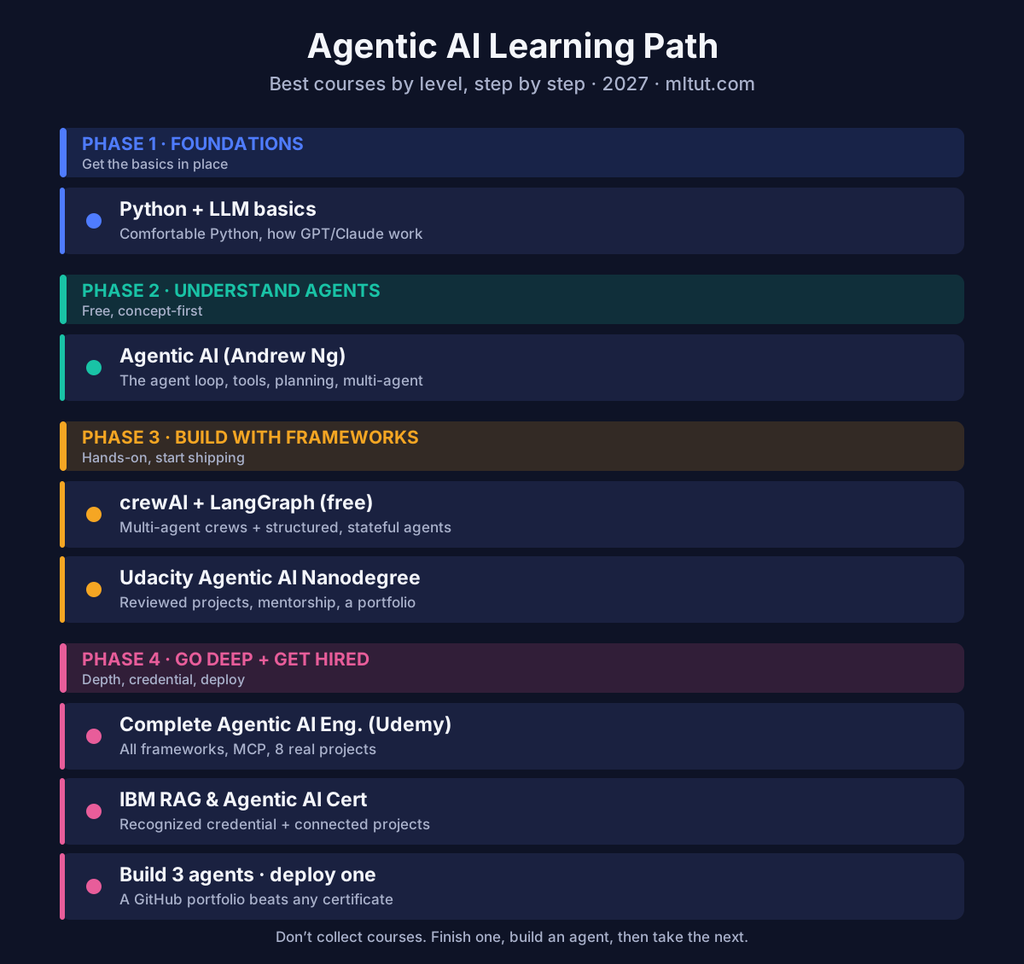
I’ve grouped these by where you are and what you want. Each one has the level, cost, what you’ll learn, the skills and projects you’ll come away with, the honest drawbacks, and my verdict. The free courses have no affiliate program, so I link those plainly, I just rate them.
1. Agentic AI, DeepLearning.AI (Andrew Ng), Free to Audit
If you want the clearest possible foundation and you want it free, start here. Andrew Ng teaches concepts better than almost anyone, and his Agentic AI course lays out the whole mental model: how agents reason, plan, use tools, reflect on their own output, and work together.
Level: Beginner to Intermediate
Cost: Free to audit (also in Coursera Plus)
What you’ll learn: the core agentic design patterns, reflection (an agent reviewing and improving its own output), tool use, planning, and multi-agent collaboration, with enough hands-on work to make them concrete rather than abstract.
Skills you’ll gain: a solid grasp of how agents reason and act, the four design patterns you can apply in any framework, and the judgment to know when an agent beats a simpler approach.
What you’ll build: small guided exercises that apply each pattern, so you leave with working examples rather than just notes.
Drawbacks and limitations:
- It’s lighter on “ship this exact production app” than the developer programs below, by design, it’s the foundation, not the capstone.
- You still need a hands-on course afterward to build real projects.
- Framework specifics are secondary, so pair it with the crewAI and LangGraph courses next.
My verdict: the best conceptual starting point on this list, and it’s free. Start here, then build.
2. DeepLearning.AI Short Courses (crewAI and LangGraph), Free
These short, free DeepLearning.AI courses are the fastest way to get your hands on the two most popular agent frameworks. I’d do both, they’re about an hour each and completely practical.
Level: Intermediate
Cost: Free
What you’ll learn: in Multi AI Agent Systems with crewAI, you build teams of agents with different roles that split up a job (one researches, one writes, one reviews) and learn memory, tools, and guardrails. In AI Agents in LangGraph, you build an agent from scratch in Python, then rebuild it in LangGraph so you feel exactly what the framework gives you: structure, state, and human-in-the-loop control.
Skills you’ll gain: designing agent roles, coordinating multiple agents, giving agents memory and tools, building guardrails, and managing state with LangGraph.
What you’ll build: working multi-agent crews (research, writing, outreach) and a structured LangGraph agent with persistence and human oversight.
Drawbacks and limitations:
- Short and framework-specific, so they won’t make you an expert on their own.
- They assume light Python, so total beginners should warm up first.
- Each covers one framework, so do both to see the two dominant approaches.
My verdict: free, practical, and the perfect next step after Andrew Ng’s course.
Take the DeepLearning.AI short courses free.
3. Agentic AI Nanodegree, Udacity (My Pick for Projects)
This is the one I completed myself, so I can speak to it from the inside. If you learn best by building real projects with feedback, and you want a portfolio at the end, this is the strongest program on the list.
Level: Beginner to Intermediate
Duration: around 3 months at about 10 hours a week
Cost: around $249 to $399/month (watch for scholarships and discounts, verify current pricing)
What you’ll learn: the core foundations of AI agents, using LangChain and function calling, building multi-agent systems with real datasets, and deploying agents into real apps and workflows. Every module ends in a working agent you build yourself.
Skills you’ll gain: building agents end to end, multi-agent coordination, function calling and tool use, deployment, and the discipline that comes from reviewed, deadline-driven work.
What you’ll build: a series of reviewed, portfolio-ready agents, not watch-along demos but projects a human mentor critiques, which is where the real learning happens.
What I gained from it: genuine hands-on practice building agents end to end, with project reviews that caught issues I’d have missed learning alone. The mentored feedback is the real value, it’s the difference between “I think this works” and someone experienced telling you why it does or doesn’t.
Drawbacks and limitations:
- It’s expensive compared to the free courses above.
- If you’re disciplined, you can assemble similar coverage yourself, you’re paying for structure, review, and the credential.
- The pace is semi-fixed by the program, which helps some people and frustrates others.
My verdict: worth it specifically if accountability is your blocker, the deadlines and reviewed projects are what get people to finish. I wrote a full, honest breakdown in my Udacity Agentic AI Nanodegree review, read that before you commit.
Enrol in the Agentic AI Nanodegree on Udacity.
4. Agentic AI and AI Agents for Leaders, Coursera (Vanderbilt)
Not everyone learning agentic AI is going to write the code. If you’re a manager, founder, or non-technical professional who needs to understand where agents fit without building them, this Vanderbilt specialization is made for you.
Level: Beginner
Cost: Coursera subscription (7-day free trial available)
What you’ll learn: how agents work and how they differ from plain automation, how to build simple no-code agents with custom GPTs, prompt engineering, and AI governance, all framed around business decisions rather than programming.
Skills you’ll gain: AI strategy, the difference between agentic AI and automation, building no-code agents, prompt engineering, and responsible-use judgment.
What you’ll build: simple no-code agents and custom GPTs, plus a practical sense of where agents fit in a real workflow.
Drawbacks and limitations:
- It’s deliberately not a developer course, so technical learners will find it light.
- It leans on OpenAI’s custom-GPT ecosystem rather than open frameworks.
- It won’t prepare you to build production agents, that’s not its goal.
My verdict: the right choice for a leader or non-coder who needs a confident grasp without programming. Use the free trial for the first course, then decide.
Start the Agentic AI and AI Agents for Leaders Specialization.
5. Building AI Agents and Agentic Workflows, Coursera (Specialization)
If you want a structured, university-style path that balances theory with hands-on labs, this Coursera specialization walks you through building agents and the workflows that connect them.
Level: Intermediate
Cost: Coursera subscription (included in Coursera Plus)
What you’ll learn: how to design agentic workflows, how multiple agents communicate and coordinate, and the practical patterns for applying agents to real business tasks, with labs along the way.
Skills you’ll gain: agentic workflow design, multi-agent coordination, and applying agents to real business problems with a structured method.
What you’ll build: lab projects that connect agents into working workflows, so you practice orchestration, not just single agents.
Drawbacks and limitations:
- It needs the Coursera subscription, so it’s best value if you’ll use Coursera for more than one course.
- The structured format means less open-ended freedom than a pure project course.
- It sits between the free short courses and the intensive developer program, so very advanced learners may want more depth.
My verdict: a solid middle ground with real labs and a university framing.
Start the Building AI Agents and Agentic Workflows Specialization.
6. The Complete Agentic AI Engineering Course, Udemy (Ed Donner)
If you want to go all the way as a developer, this is the deepest course here, and the one I’d reach for to get properly hands-on across every framework in one place. Ed Donner built it to be genuinely comprehensive, tens of thousands of students are in it, and you build a stack of real projects rather than toy demos.
Level: Intermediate to Advanced
Cost: one-time Udemy purchase (wait for a sale)
What you’ll learn: building agents with the OpenAI Agents SDK, CrewAI, LangGraph, and AutoGen, wiring up tools and MCP (Model Context Protocol, the standard most 2024-era courses miss entirely), and shipping multiple complete agentic projects.
Skills you’ll gain: the full agent-engineering stack across four major frameworks, tool and MCP integration, multi-agent design, and framework judgment, knowing which tool fits which problem.
What you’ll build: multiple real agentic projects across the frameworks, so you leave with a portfolio that proves you can build, not just a certificate.
Drawbacks and limitations:
- It’s a lot, plan real hours, not a weekend.
- It’s self-paced with no mentor, so discipline is on you.
- The pace is brisk because of the breadth, so expect to pause and rebuild as you go.
My verdict: for depth-per-rupee, nothing else here comes close. Never pay full price, the Udemy sales run constantly. (Verify the current title and number of students before publishing.)
Grab The Complete Agentic AI Engineering Course on Udemy when it’s discounted.
7. RAG and Agentic AI Professional Certificate, Coursera (IBM)
If you want one structured program that takes you end to end and leaves you with a recognized credential on your LinkedIn, this IBM Professional Certificate is the strongest option here.
Level: Intermediate
Cost: Coursera subscription
What you’ll learn: RAG systems, LangChain and agent frameworks, multi-agent concepts, and how to build and evaluate agentic applications, all building toward portfolio projects, with IBM’s name on the certificate.
Skills you’ll gain: RAG, LangChain and agent frameworks, multi-agent design, evaluation, and a recognized IBM credential.
What you’ll build: a connected sequence of projects culminating in agentic applications, so you finish with a coherent portfolio rather than scattered demos.
Drawbacks and limitations:
- It’s a bigger time commitment across several courses.
- You’ll want the Coursera subscription since it spans the whole program.
- It’s strong on the IBM/LangChain path, so pair it with Ed Donner’s course for the broader framework landscape.
My verdict: the credential route, structure plus a recognized certificate plus connected project work.
Start the RAG and Agentic AI Professional Certificate.
8. Agentic AI Courses on edX (University and IBM Options)
A lot of people specifically look for agentic AI courses on edX, often to compare the university-backed and IBM options, so let me give you the honest picture. edX hosts agentic AI and AI agents courses from universities and from IBM’s skills catalog, ranging from beginner “build your first agent” courses to more advanced, research-leaning programs with an audit-free option.
Level: Beginner to Advanced (varies by course)
Cost: many offer a free audit, with a paid certificate option
What you’ll learn: depending on the course, the fundamentals of autonomous agents, multi-agent systems, tool use, and the ethics and safety considerations around deploying agents, usually with a more academic framing than the hands-on developer courses above.
Skills you’ll gain: agent fundamentals, multi-agent concepts, and a stronger theoretical and ethical grounding than most purely practical courses give.
Drawbacks and limitations:
- It’s more academic, so if you want the fastest build-everything path, Udacity or Ed Donner’s course win.
- Course quality and currency vary by institution, so check the syllabus and update date.
- The best agentic edX courses change, so confirm the current title and price before enrolling.
My verdict: strong if you value the academic framing and the audit option. Pick the specific edX agentic course that matches your level.
Browse the agentic AI courses on edX.
9. Free Hands-On Resources and Open-Source Frameworks
Prefer learning by building? These free, open-source frameworks are how real agents get built, and experimenting with them is some of the best practice you can get:
- LangChain and LangGraph: the most widely used frameworks for building and structuring agents.
- CrewAI: the cleanest way to build teams of role-based agents.
- AutoGen: Microsoft’s framework for conversational multi-agent systems.
- LlamaIndex: a data framework for building agents over your own documents.
- Microsoft Semantic Kernel: a model-agnostic SDK for orchestrating agents.
Pair these with structured courses rather than using them alone. The course teaches you the concepts, the frameworks let you build.
Learn Agentic AI Free on My YouTube Channel
There’s something no course catalog can give you: watching someone actually build these systems, mistakes included. On my channel I build agents in public, and these videos map directly onto the courses above. They’re free, and they’re the fastest way to see the concepts in action.
- AI Agents Are Not What You Think: the honest definition before you spend money.
- What is LangGraph? Build Your First AI Agent (Locally with Ollama): your first real agent, running on your own machine.
- I Built a Deep Research AI Agent with LangGraph: a full, real project you can follow.
- Deep Agent Tutorial: Build an AI Research Agent with LangChain and Python: building an agent step by step.
- LangChain vs LangGraph vs LangSmith: Which One Do You Actually Need?: clears up the framework confusion.
- MCP Tutorial: Build Your First MCP Server with LangChain: the newest piece of the agentic stack.
- Why Your RAG App Fails in Production (And How Agentic RAG Actually Fixes It): for when you’re ready to go deeper.
Watch along, build the projects, and put them on GitHub. A portfolio of agents you built yourself beats any certificate on this page.
Course Comparison Table
| Course / Resource | Platform | Level | Cost | Best for |
|---|---|---|---|---|
| Agentic AI (Andrew Ng) | DeepLearning.AI | Beginner to Intermediate | Free to audit | The clearest free foundation |
| crewAI and LangGraph | DeepLearning.AI | Intermediate | Free | Fast hands-on with frameworks |
| Agentic AI Nanodegree | Udacity | Beginner to Intermediate | ~$249 to $399/mo | Projects + mentorship (my pick) |
| Agentic AI and AI Agents for Leaders | Coursera (Vanderbilt) | Beginner | Coursera sub | Non-technical leaders |
| Building AI Agents and Agentic Workflows | Coursera | Intermediate | Coursera sub | Structured theory + labs |
| The Complete Agentic AI Engineering | Udemy (Ed Donner) | Intermediate to Advanced | One-time (on sale) | Developers going deep |
| RAG and Agentic AI Professional Certificate | Coursera (IBM) | Intermediate | Coursera sub | A recognized credential |
| Agentic AI Courses | edX | Beginner to Advanced | Audit free / paid cert | University / IBM-backed path |
| Open-source frameworks | Free | Varies | Free | Hands-on experimentation |
How to Choose the Right Agentic AI Course
With this many options, let me show you how I’d actually pick, depending on who you are.
“I’m brand new and want to start free.” Andrew Ng’s Agentic AI for the concepts, then the free DeepLearning.AI short courses to build. Zero spend, and you’ll be ahead of most people.
“I want projects, mentorship, and a portfolio.” The Udacity Agentic AI Nanodegree. It’s the one I did, and the structure is worth it if free courses don’t stick for you.
“I’m a leader and just need to get it.” Agentic AI for Leaders on Coursera. Don’t overthink it.
“I’m a developer and want to go all the way.” Ed Donner’s Complete Agentic AI Engineering Course on Udemy, backed by the IBM credential if you want something recognized for your resume.
One rule above all: don’t collect courses. Finish one, build one agent of your own from scratch, then take the next. The people who get hired have a GitHub full of working agents, not a wall of certificates.
Agentic AI Projects to Build (Your Portfolio)
The fastest way to turn a course into a job is to build your own agents and show them. Here are project ideas from easiest to hardest. Do them as you progress, put each on GitHub, and write up what broke and how you fixed it.
- A research agent: give it a topic, and it searches, reads, and writes you a short briefing. The classic first agent.
- A personal assistant agent: one that reads your calendar and drafts or schedules emails based on simple rules.
- A file-organizing agent: point it at a messy folder and have it sort and rename files. (I built exactly this on my channel.)
- An agentic RAG app: an agent that answers questions from your own documents and decides when to retrieve more. This is the project that gets you noticed.
- A multi-agent workflow: several agents with roles (researcher, writer, reviewer) that complete a task together.
- An autonomous monitor agent: one that watches a data source and alerts or acts when something changes.
Each project is a resume line and an interview story. Build three of these and you’re ahead of most applicants, certificate or not.
Important Agentic AI Terms
You’ll meet these words everywhere. Below is a plain-English glossary so none of them trip you up.
- Agent: an AI system that can reason, use tools, and take actions toward a goal, not just answer once.
- Agentic AI: the broader approach of building AI that plans, remembers, and acts with autonomy.
- LLM (Large Language Model): the generative model that acts as an agent’s “brain.”
- Tool use: giving an agent the ability to take actions, searching, running code, calling an API.
- Reason, act, observe loop: the core cycle an agent repeats until its goal is met.
- Memory: how an agent remembers the current task (short-term) and past sessions (long-term).
- Multi-agent system: several agents with different roles working together on a goal.
- Orchestration: the logic that runs the loop, coordinates agents, and decides when to stop.
- RAG (Retrieval-Augmented Generation): feeding an agent relevant documents so it answers from real sources instead of memory.
- Guardrails: the limits that keep an agent from looping forever, hallucinating, or taking unsafe actions.
- MCP (Model Context Protocol): a standard for connecting agents to tools and data cleanly.
- Autonomy: how much an agent can do on its own without being prompted at each step.
Career Opportunities After Learning Agentic AI
After you’ve built real agentic AI skills, these are the roles that open up:
- AI Agent Developer / Agentic AI Engineer: builds and ships agent systems. The most direct destination.
- Generative AI Engineer: builds generative and agentic AI products end to end.
- Applied AI Scientist: more research-leaning, often needs stronger math.
- Conversational AI Engineer: focused on agent-driven conversational systems.
- AI Workflow Automation Specialist: designs agent-driven automation across a business.
On pay, these are among the better-compensated roles in tech because the supply of people who can genuinely build is still thin. Global averages run roughly: entry-level around $80k to $110k, mid-level around $120k to $160k, and senior or research roles $180k and up. In India, comparable roles typically range from about ₹8 to ₹40 LPA depending on experience. (Numbers vary a lot by location, company, and experience, and these move fast, so treat them as a guide and refresh against current listings before publishing.)
The reason the pay holds up is simple. Anyone can prompt a model. Far fewer people can build an agent that reliably uses tools, remembers state, and completes a multi-step task without falling over. That gap is exactly what these courses close.
Common Mistakes People Make Learning Agentic AI
Avoid these and you’ll move faster than most.
Jumping to agents before understanding LLMs. Agents are built on language models. If LLMs are new to you, learn those first, or the agent frameworks will feel like a black box.
Collecting courses instead of building. Watching ten tutorials and building nothing is worth less than one course plus one agent you built. Build at every step.
Learning one framework and forcing it everywhere. The good engineers know LangGraph, CrewAI, and the OpenAI SDK well enough to pick the right one. Breadth is important here.
Skipping evaluation and guardrails. An agent that works once in a demo and loops forever in production isn’t finished. Learn to test and constrain your agents.
Never deploying anything. An agent on your laptop is invisible to employers. Ship one small one so someone can actually see it.
FAQ
Final Thoughts
AAgentic AI is still early, which is exactly why learning it now gives you an edge. The field is moving from reactive chatbots to systems that plan and act, and the people who can build those are in short supply.
My honest advice: don’t buy five courses. Start free with Andrew Ng’s Agentic AI and the DeepLearning.AI short courses, build one small agent of your own, and only then decide if you want the projects and mentorship of the Udacity Nanodegree, the depth of Ed Donner’s course, or the credential of IBM’s certificate. The course teaches you. The building is what gets you hired.
Pick the one that matches where you are, and go build something this week. For my full course-by-course ranking, see Best AI Agent Courses, and if LLMs are still new to you, start with my how to learn LLMs roadmap.
And if you want to see what building agents actually looks like, LangGraph, RAG, MCP, local models, all of it, come subscribe on YouTube, where I build this out in the open, messy parts included. If you’ve tried any of these agentic AI courses, share your experience in the comments, it helps the whole community.
Happy Learning!
You May Also Be Interested In
Best Resources to Learn Computer Vision (YouTube, Tutorials, Courses, Books, etc.)- 2026
Best Certification Courses for Artificial Intelligence- Beginner to Advanced
Best Natural Language Processing Courses Online to Become an Expert
Best Artificial Intelligence Courses for Healthcare You Should Know in 2026
What is Natural Language Processing? A Complete and Easy Guide
Best Books for Natural Language Processing You Should Read
Augmented Reality Vs Virtual Reality: Differences You Need To Know!
What are Artificial Intelligence Examples? Real-World Examples
Thank YOU!
Explore more about Artificial Intelligence.
Thought of the Day…
‘ It’s what you learn after you know it all that counts.’
– John Wooden

Written By Aqsa Zafar
Aqsa Zafar is a Ph.D. scholar in Machine Learning at Dayananda Sagar University, specializing in Natural Language Processing and Deep Learning. She has published research in AI applications for mental health and actively shares insights on data science, machine learning, and generative AI through MLTUT. With a strong background in computer science (B.Tech and M.Tech), Aqsa combines academic expertise with practical experience to help learners and professionals understand and apply AI in real-world scenarios.